1 mL BAC
25 units
resulting U-100 draw
- Concentration
- 10 mg/mL
- BAC added
- 1 mL
Shown in the diagram. Closest of these examples to 25 units.
A GIP and GLP-1 receptor agonist with authorised prescription products. Label regimens apply only to regulated medicines under clinical care.
Quantities below reproduce their stated source context—label, human study, laboratory work or educational guide. They do not assess suitability, product equivalence or individual risk.
US label schedule
The interactive line reproduces the Zepbound label's 2.5 mg starting quantity and four-week minimum intervals between 2.5 mg increases.
Vial-aware arithmetic
Choose the vial quantity and BAC water first. The diagram and results below update for the selected 2.5 mg study quantity. Higher-strength vials may naturally land outside the 20-30 unit band.
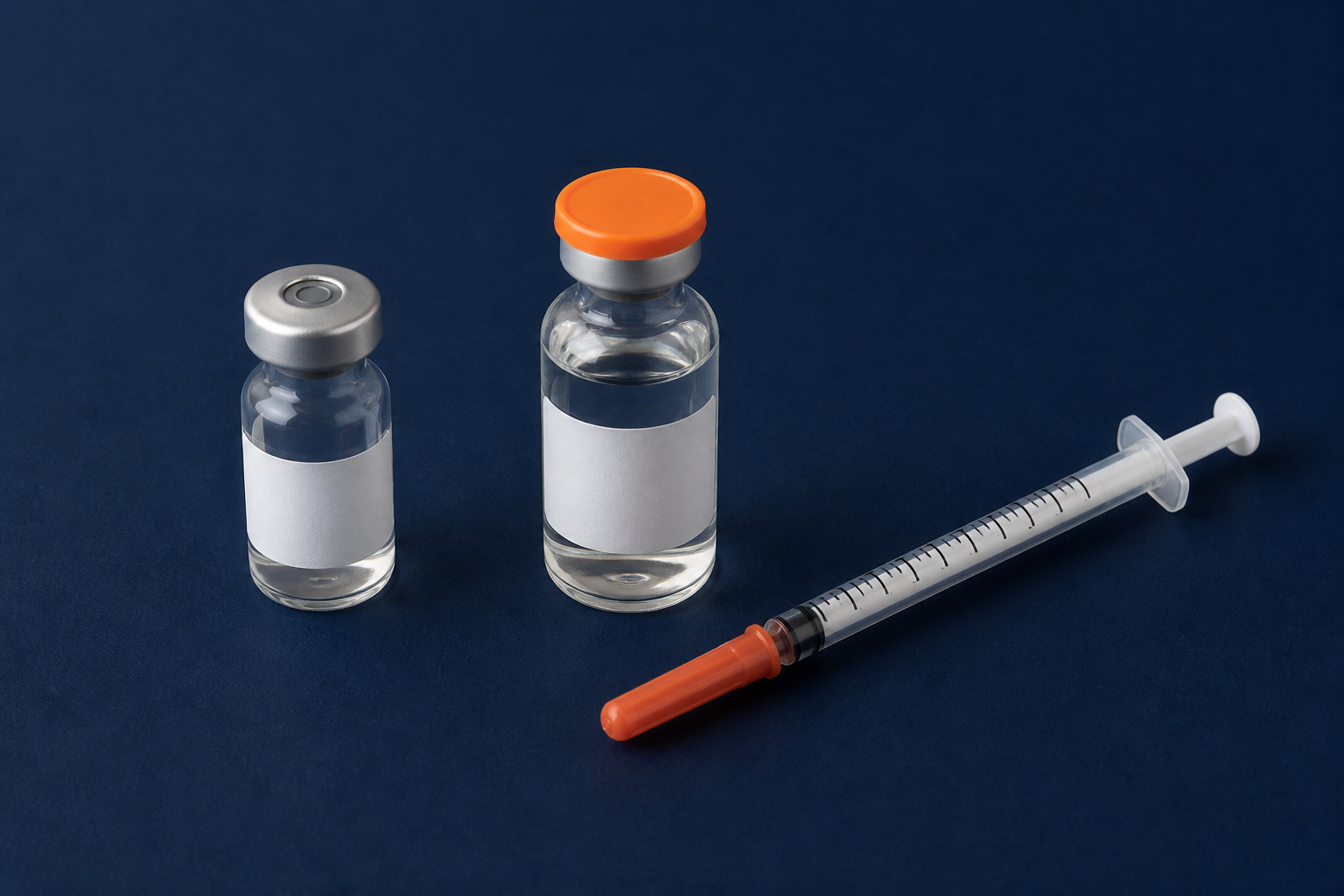
Basic example limit: 3 mL maximum. Check the actual vial and product-specific limits.
resulting U-100 draw
Shown in the diagram. Closest of these examples to 25 units.
resulting U-100 draw
resulting U-100 draw
Formula: draw units = selected mg × BAC mL ÷ vial mg × 100. The 20-30 unit band is a measurement reference, not a recommendation. Results are mathematical examples, not preparation instructions.
Each card states what the quantities are based on. A third-party or animal schedule is not a validated human dose.
The label starts at 2.5 mg once weekly and uses 2.5 mg escalation steps after at least 4 weeks at the current dose
This is a summary of a US prescription label and is not a recommendation for a research product.
View sourceNon-label reports include split or every-five-day schedules and maintenance quantities from 1.25 mg weekly to 2.5 mg every other week
These schedules are community experiments and must remain separate from the once-weekly label. The archive's AUC discussion is not a validated dose-conversion rule; dosing-summaries/02-tirzepatide-semaglutide.md:33-47.
View sourceSubcutaneous 2.5 mg weekly is the standard start, but a large low-and-slow group begins near 1 mg weekly (sometimes split as 0.75 mg twice weekly or 1 mg on Monday, Wednesday and Friday) and titrates only as needed; many shorten the interval from every seven days to every five (or four) days when appetite returns, and maintenance reports settle at every five to seven days
Forum provenance from an authenticated archive with usernames omitted. Shorter intervals are described as raising accumulation and side-effect risk rather than a validated conversion; injection-site reactions and telogen-effluvium hair loss are discussed. Quantities conflict and are community provenance, not label instructions.
View sourceTirzepatide has regulated prescription formulations for specific indications. Regulatory status does not transfer to unlicensed or research-labelled material.
The current product label is the controlling source for indications, dosage forms, warnings, interactions, pregnancy information and storage. A prescriber must determine whether it is appropriate for an individual.
An authenticated research-forum archive records subcutaneous tirzepatide with a standard 2.5 mg weekly opening dose alongside a large low-and-slow subculture that begins near 1 mg weekly, sometimes split as 0.75 mg twice weekly or across Monday, Wednesday and Friday, and titrates only as needed. A recurring theme is shortening the interval from every seven days to every five or four days when appetite returns before the next dose, which the archive frames as raising accumulation and side-effect risk rather than a validated conversion; maintenance reports settle at every five to seven days. Injection-site reactions and telogen-effluvium hair loss are discussed. Usernames are omitted and figures are logged as community provenance without endorsement; these reports do not alter the label schedule above.
Shared across protocols
Keep the universal checklist short. Product-specific labelling and source documentation always take priority over a general guide.
Select the labelled vial quantity used in the calculation.
View Peppys vialUse only a diluent appropriate to the research method and formulation.
View Peppys BAC waterUse a new sterile device for every entry. Source locally.
Source locallyPlan clean handling and immediate sharps disposal. Source locally.
Source locallyDo not apply a universal refrigerator rule. Follow the product, diluent and study documentation for temperature, light and expiry.
CDC injection-safety guidance calls for a new sterile needle and syringe for each injection and entry into a medication container.
Do not infer a post-mixing lifetime from BAC water alone. Discard material when identity, integrity or sterility is in doubt.