1 mL BAC
9 units
resulting U-100 draw
- Concentration
- 5 mg/mL
- BAC added
- 1 mL
An immune-modulating peptide used in some jurisdictions and studied across highly varied infections, liver disease and immune conditions.
Quantities below reproduce their stated source context—label, human study, laboratory work or educational guide. They do not assess suitability, product equivalence or individual risk.
Community-reported schedule
Community-reported · not a validated scheduleTwo community-provenance subcutaneous lines from an authenticated research forum - a daily microdose near 450 mcg and a 1.5 mg every-third-day pulse. Community reports only, not a validated or clinician-directed schedule.
Vial-aware arithmetic
Choose the vial quantity and BAC water first. The diagram and results below update for the selected 450 mcg reported quantity. Higher-strength vials may naturally land outside the 20-30 unit band.
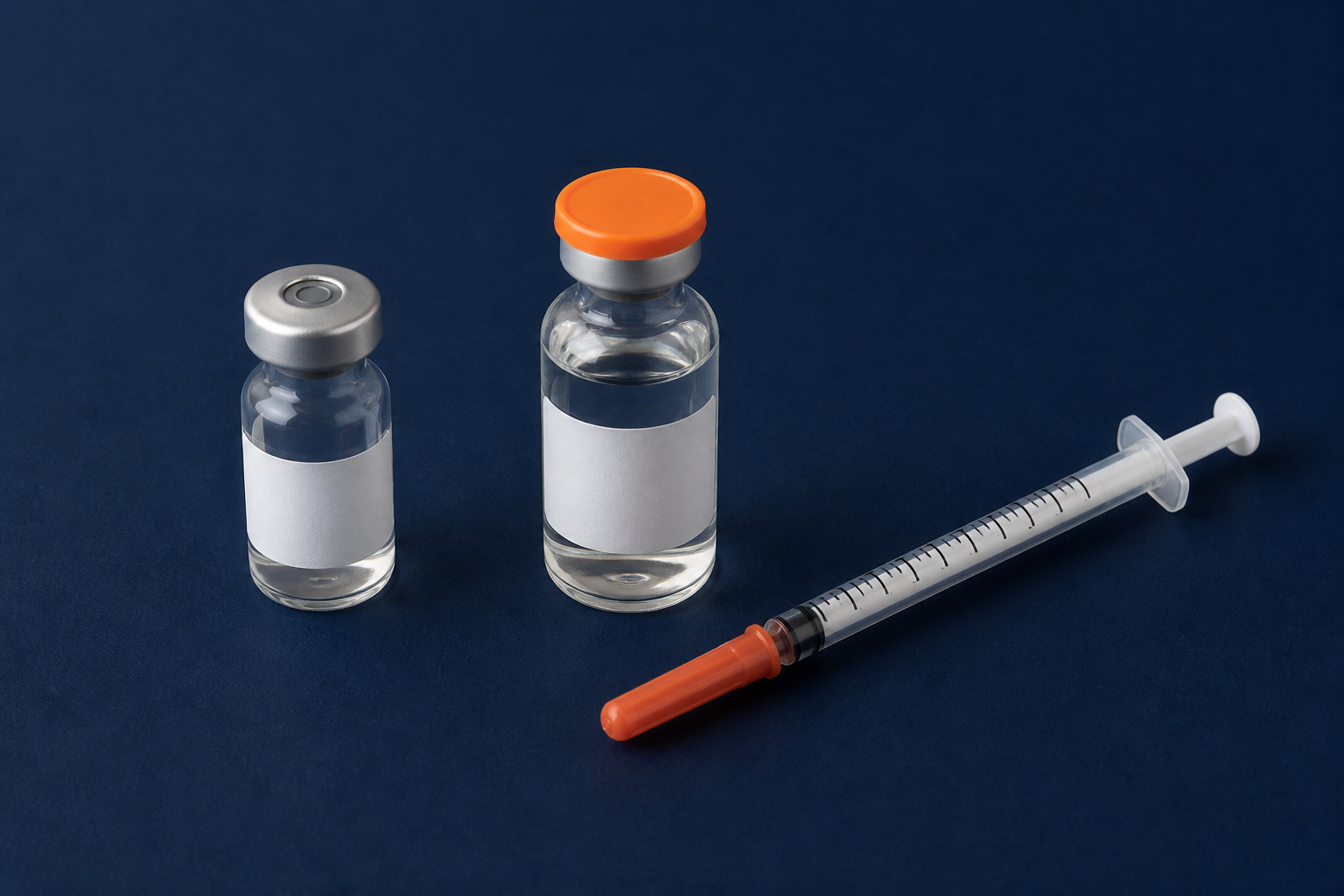
Basic example limit: 3 mL maximum. Check the actual vial and product-specific limits.
resulting U-100 draw
resulting U-100 draw
resulting U-100 draw
Shown in the diagram. Closest of these examples to 25 units.
Formula: draw units = selected mg × BAC mL ÷ vial mg × 100. The 20-30 unit band is a measurement reference, not a recommendation. Results are mathematical examples, not preparation instructions.
Each card states what the quantities are based on. A third-party or animal schedule is not a validated human dose.
1.6 mg subcutaneously twice weekly in several disease-specific programmes
The review found mixed hepatitis results and does not support transferring this schedule across indications.
View source1.6 mg subcutaneously daily for one week, then twice weekly for seven weeks
This was a very small open-label proof-of-concept study, not confirmatory evidence.
View sourceThe spotlight repeats 1.6 mg subcutaneously twice weekly; community immune blends also use 500 mcg TA-1 plus 300 mcg thymulin daily with short higher-dose periods
Blend compositions and seasonal or vaccine-adjunct schedules conflict within the channel and are not quality-controlled clinical protocols; raw/peptide-education/pe-thymosin-alpha1.md:18-25 and 58-69.
View sourceSubcutaneous daily microdosing clusters around 400-500 mcg (a reference chart lists 450 mcg daily), frequently run 20 days on and 10 days off; a separate clinician-derived pulse of 1.5 mg every third day is raised toward 3 mg daily at the onset of a cold, and an immune-stack maintenance figure near 500 mcg daily also appears
Forum provenance from an authenticated archive with usernames omitted. Reported quantities and cadences conflict, the archive frames all use as research-subject use, and a widely repeated short-shelf-life claim is described there as a debunked myth. Routes are kept as subcutaneous, with a separate nasal-spray form noted independently.
View sourceAn immune-modulating peptide used in some jurisdictions and studied across highly varied infections, liver disease and immune conditions.
The page reports common disease-specific research schedules while emphasising that regulatory status and evidence vary by jurisdiction and indication.
An authenticated research-forum archive records two recurring subcutaneous patterns: a daily microdose in the region of 400-500 mcg, frequently cycled 20 days on and 10 days off, and a clinician-derived pulse of roughly 1.5 mg every third day that some raise toward 3 mg daily at the onset of a cold. An immune-stack maintenance figure near 500 mcg daily also appears. The archive notes that thymosin alpha-1 is authorised as Zadaxin in some jurisdictions, treats a widely repeated short-shelf-life claim as a debunked myth, and records conflicting quantities and cadences alongside a separate nasal-spray form. Usernames are omitted and figures are logged as community provenance without endorsement. The planner above reproduces the arithmetic of these reported subcutaneous quantities; it does not validate them.
Which patients benefit, how schedules compare, long-term outcomes and applicability to unregulated vials remain uncertain.
Shared across protocols
Keep the universal checklist short. Product-specific labelling and source documentation always take priority over a general guide.
Select the labelled vial quantity used in the calculation.
View Peppys vialUse only a diluent appropriate to the research method and formulation.
View Peppys BAC waterUse a new sterile device for every entry. Source locally.
Source locallyPlan clean handling and immediate sharps disposal. Source locally.
Source locallyDo not apply a universal refrigerator rule. Follow the product, diluent and study documentation for temperature, light and expiry.
CDC injection-safety guidance calls for a new sterile needle and syringe for each injection and entry into a medication container.
Do not infer a post-mixing lifetime from BAC water alone. Discard material when identity, integrity or sterility is in doubt.