1 mL BAC
20 units
resulting U-100 draw
- Concentration
- 50 mg/mL
- BAC added
- 1 mL
Shown in the diagram. Closest of these examples to 25 units.
A mitochondria-targeting peptide approved in the US as Forzinity for a narrow Barth-syndrome population. The authorised formulation and indication do not validate generic SS-31 products.
Quantities below reproduce their stated source context—label, human study, laboratory work or educational guide. They do not assess suitability, product equivalence or individual risk.
Community-reported schedule
Community-reported · not a validated scheduleTwo community-provenance subcutaneous lines for SS-31 (elamipretide) - a protocol author's short daily cycle and a lower everyday band. Community reports only, not the Forzinity label or a trial-verified schedule.
Vial-aware arithmetic
Choose the vial quantity and BAC water first. The diagram and results below update for the selected 10 mg reported quantity. Higher-strength vials may naturally land outside the 20-30 unit band.
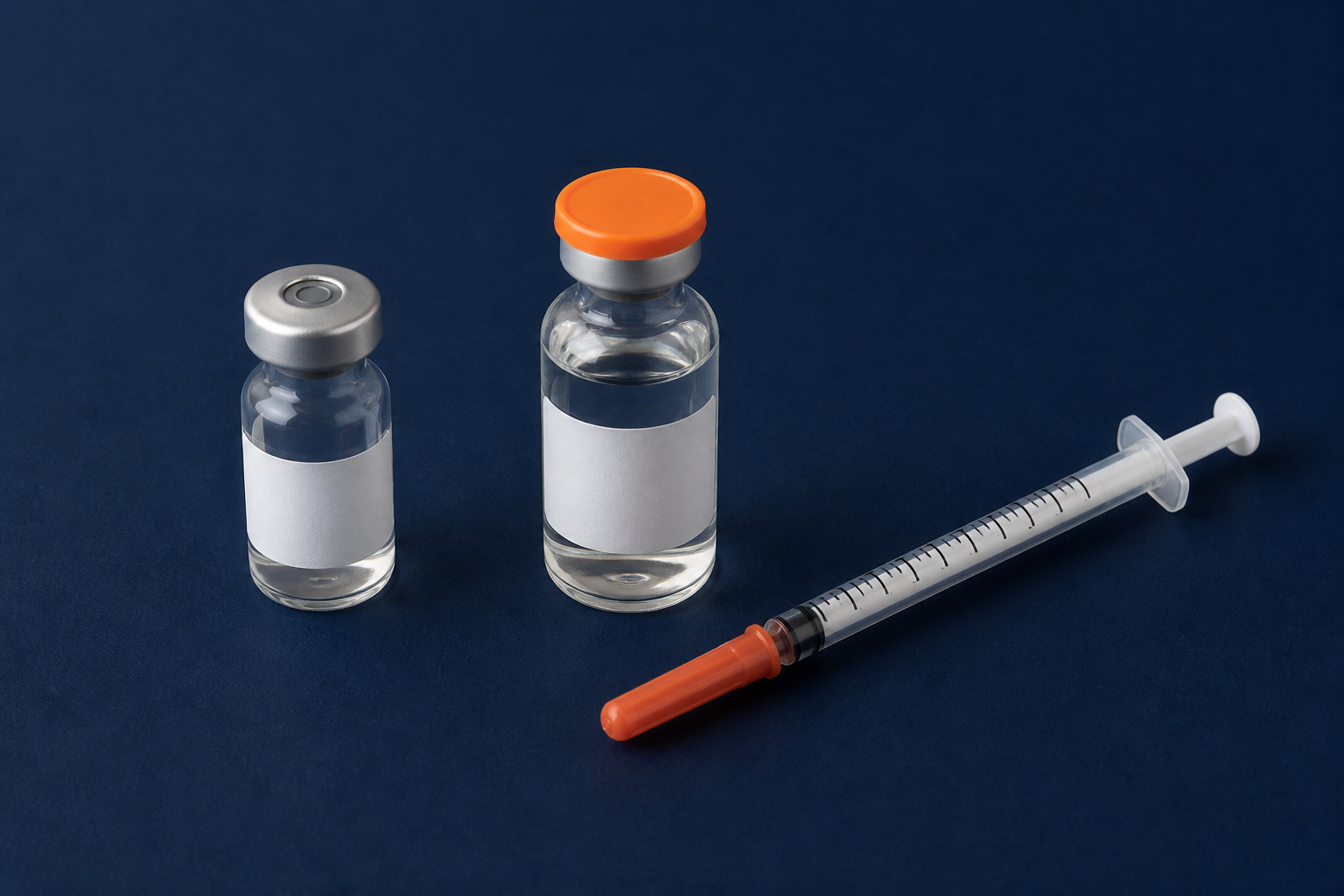
Basic example limit: 3 mL maximum. Check the actual vial and product-specific limits.
resulting U-100 draw
Shown in the diagram. Closest of these examples to 25 units.
resulting U-100 draw
resulting U-100 draw
Formula: draw units = selected mg × BAC mL ÷ vial mg × 100. The 20-30 unit band is a measurement reference, not a recommendation. Results are mathematical examples, not preparation instructions.
Each card states what the quantities are based on. A third-party or animal schedule is not a validated human dose.
40 mg subcutaneously once daily using the authorised Forzinity formulation
This US accelerated-approval schedule is indication- and formulation-specific. The label requires dose reduction for adults with severe renal impairment and does not establish equivalence to research vials.
View source40 mg subcutaneously once daily for 24 weeks
MMPOWER-3 was a monitored phase 3 trial and did not improve its primary walking-distance or fatigue endpoints.
View source40 mg subcutaneously once daily for four weeks in a crossover study
This small phase 2 study generated signals that were not confirmed on the phase 3 primary endpoints.
View sourceThe spotlight states 1-5 mg subcutaneously daily or several times weekly, while reported stacks span 0.5-16 mg daily and 25-50 mg pulse schedules
The archive ranges exceed 100-fold and are not comparable with the indication-specific Forzinity label. They are practitioner and community protocols, not a consensus; raw/peptide-education/pe-ss31.md:18-29 and raw/peptide-education/pe-mitochondrial-protocols.md:20-54.
View sourceA protocol author describes about 10 mg subcutaneously daily for 10-20 days then a break before MOTS-C; the common real-world band is 3-5 mg daily, with reports spanning 0.5-16 mg daily up to 25-50 mg pulse schedules and doubted 200-250 mcg microdoses
Forum provenance from an authenticated archive with usernames omitted. SS-31 (elamipretide) is used subcutaneously, almost always as the first leg of a mitochondrial stack into MOTS-C. Quantities conflict by more than 100-fold, human data is described as thin, and these are community protocols rather than a consensus or the indication-specific Forzinity label.
View sourceA mitochondria-targeting peptide now authorised in the US as Forzinity for eligible patients with Barth syndrome weighing at least 30 kg. Approval is accelerated and indication-specific; earlier mitochondrial-myopathy trials remain separate evidence.
The protocol is anchored first to the authorised Forzinity formulation and label, then to matched elamipretide trials. Generic products labelled SS-31 are not established as equivalent to the approved medicine.
An authenticated research-forum archive records SS-31 (elamipretide) used subcutaneously, almost always as the first leg of a mitochondrial stack into MOTS-C. A protocol author describes roughly 10 mg daily for 10-20 days followed by a break, while the common everyday band is about 3-5 mg daily; reported quantities range more than 100-fold, from doubted 200-250 mcg microdoses up to 25-50 mg pulse schedules. The archive stresses thin human data and keeps these community protocols separate from the indication-specific Forzinity label. Usernames and post numbers are omitted. The planner above reproduces the arithmetic of these reported quantities; it does not validate them.
Confirmatory clinical benefit under accelerated approval, generalisability beyond Barth syndrome and equivalence to products labelled only SS-31 remain unresolved.
Shared across protocols
Keep the universal checklist short. Product-specific labelling and source documentation always take priority over a general guide.
Select the labelled vial quantity used in the calculation.
View Peppys vialUse only a diluent appropriate to the research method and formulation.
View Peppys BAC waterUse a new sterile device for every entry. Source locally.
Source locallyPlan clean handling and immediate sharps disposal. Source locally.
Source locallyDo not apply a universal refrigerator rule. Follow the product, diluent and study documentation for temperature, light and expiry.
CDC injection-safety guidance calls for a new sterile needle and syringe for each injection and entry into a medication container.
Do not infer a post-mixing lifetime from BAC water alone. Discard material when identity, integrity or sterility is in doubt.