1 mL BAC
2 units
resulting U-100 draw
- Concentration
- 5 mg/mL
- BAC added
- 1 mL
A synthetic ACTH fragment analogue studied mainly in Russian-language and intranasal contexts. Evidence does not map cleanly to a reconstituted injectable vial.
Quantities below reproduce their stated source context—label, human study, laboratory work or educational guide. They do not assess suitability, product equivalence or individual risk.
Community-reported schedule
Community-reported · not a validated scheduleA community-provenance subcutaneous line from an authenticated research forum - roughly 100 to 250 mcg daily. The archive's common route is intranasal, shown separately. Community reports only, not a validated schedule.
Vial-aware arithmetic
Choose the vial quantity and BAC water first. The diagram and results below update for the selected 100 mcg reported quantity. Higher-strength vials may naturally land outside the 20-30 unit band.
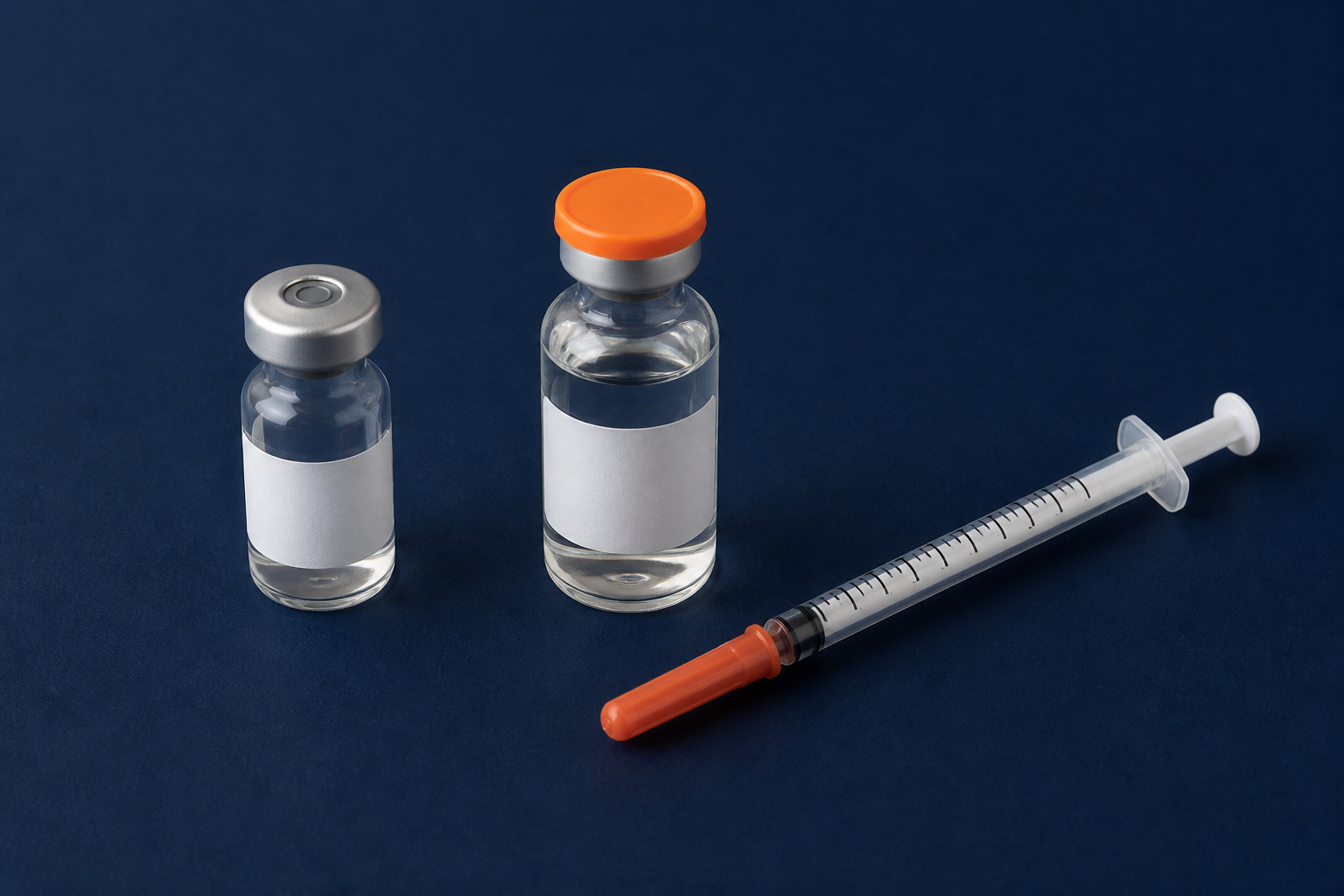
Basic example limit: 3 mL maximum. Check the actual vial and product-specific limits.
resulting U-100 draw
resulting U-100 draw
resulting U-100 draw
Shown in the diagram. Closest of these examples to 25 units.
Formula: draw units = selected mg × BAC mL ÷ vial mg × 100. The 20-30 unit band is a measurement reference, not a recommendation. Results are mathematical examples, not preparation instructions.
Each card states what the quantities are based on. A third-party or animal schedule is not a validated human dose.
A 5 mg vial at a measured 5 mL final volume yields 1 mg/mL and 100 mcg per spray; 10 mL yields 0.5 mg/mL and 50 mcg per spray
This is concentration and actuator arithmetic, not a universal dose. Pump output, vehicle, priming, stability and the exact formulation must be independently established.
View sourceReported protocols ranged from single 0.25-1.2 mg exposures to a condition-specific 6 mg daily, 10-day post-stroke course
These distinct studies used different populations and formulations. Their quantities should be read individually rather than combined into one schedule.
View sourceThe spotlight states 300-600 mcg daily divided intranasally or subcutaneously; other channel summaries span 750-1,000 mcg intranasally daily or 100-300 mcg subcutaneously daily
Condition-specific intranasal schedules in the same channel rise to 6-12 mg daily for 10 days. Route equivalence and cycling are not established, so these ranges must not be merged into one protocol; raw/peptide-education/pe-semax.md:18-29 and 53-78.
View sourceSemax is used mostly intranasally at roughly 100 mcg per nostril up to about 250 mcg per spray, dosed early in the day; a vendor chart also lists 100 mcg (0.1 mL) subcutaneously daily, and one report ran 500 mcg per day intranasally on a 20-days-on, 10-days-off cycle. N-Acetyl Semax Amidate is run at a lower dose as a more potent variant
Forum provenance with usernames omitted. Intranasal is the dominant route and experts insist it be reconstituted with nasal saline rather than bacteriostatic water; intranasal and subcutaneous quantities are kept separate rather than interconverted.
View sourceA synthetic ACTH fragment analogue studied mainly in Russian-language and intranasal contexts. Evidence does not map cleanly to a reconstituted injectable vial.
This page reports the formulation mismatch as part of the protocol: published intranasal work is not converted into injectable quantities.
An authenticated research-forum archive uses Semax mainly as an intranasal nootropic, clustering around 100 mcg per nostril up to about 250 mcg per spray and dosed early in the day to limit insomnia. A vendor chart in the same archive lists a 100 mcg subcutaneous daily figure, and one report ran 500 mcg per day intranasally on a 20-days-on, 10-days-off cycle; the more potent N-Acetyl Semax Amidate is run at a lower dose. Experts insist intranasal Semax be reconstituted with nasal saline rather than bacteriostatic water, and the intranasal and subcutaneous quantities are kept separate rather than interconverted. Usernames are omitted; the planner above reflects only the subcutaneous line while the archive's common route is intranasal, and it reproduces the arithmetic without validating it.
Independent replication, route-specific bioavailability, long-term safety and equivalence to research products remain uncertain.
Shared across protocols
Keep the universal checklist short. Product-specific labelling and source documentation always take priority over a general guide.
Select the labelled vial quantity used in the calculation.
View Peppys vialUse only a diluent appropriate to the research method and formulation.
View Peppys BAC waterUse a new sterile device for every entry. Source locally.
Source locallyPlan clean handling and immediate sharps disposal. Source locally.
Source locallyDo not apply a universal refrigerator rule. Follow the product, diluent and study documentation for temperature, light and expiry.
CDC injection-safety guidance calls for a new sterile needle and syringe for each injection and entry into a medication container.
Do not infer a post-mixing lifetime from BAC water alone. Discard material when identity, integrity or sterility is in doubt.