1 mL BAC
3 units
resulting U-100 draw
- Concentration
- 5 mg/mL
- BAC added
- 1 mL
A synthetic heptapeptide studied in small human and laboratory studies, with limited internationally accessible clinical evidence and no UK marketing authorisation.
Quantities below reproduce their stated source context—label, human study, laboratory work or educational guide. They do not assess suitability, product equivalence or individual risk.
Community-reported schedule
Community-reported · not a validated scheduleA community-provenance subcutaneous line from an authenticated research forum - roughly 150 to 300 mcg daily, sometimes cycled two weeks on and one week off. Intranasal use is a separate route. Community reports only, not validated.
Vial-aware arithmetic
Choose the vial quantity and BAC water first. The diagram and results below update for the selected 150 mcg reported quantity. Higher-strength vials may naturally land outside the 20-30 unit band.
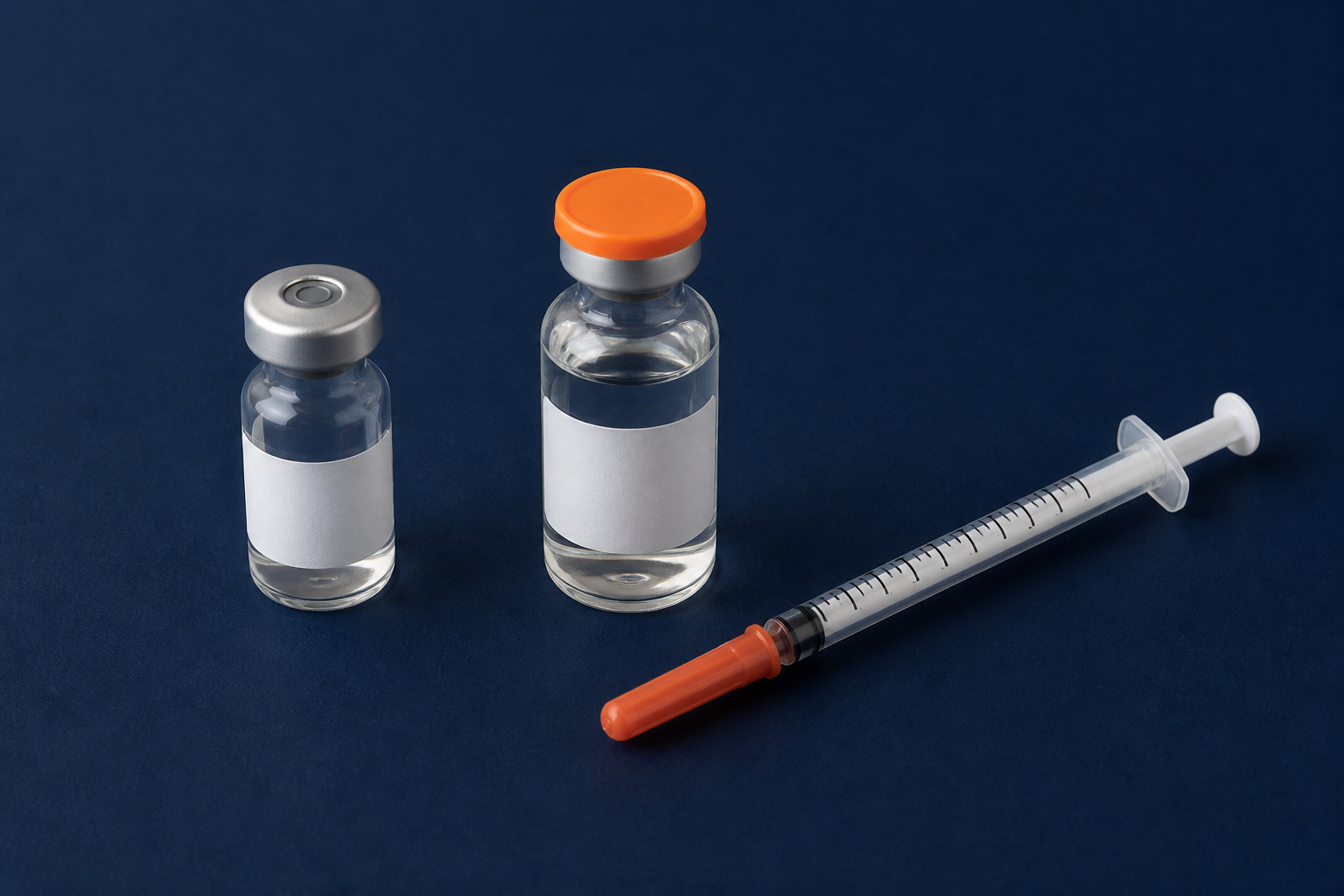
Basic example limit: 3 mL maximum. Check the actual vial and product-specific limits.
resulting U-100 draw
resulting U-100 draw
resulting U-100 draw
Shown in the diagram. Closest of these examples to 25 units.
Formula: draw units = selected mg × BAC mL ÷ vial mg × 100. The 20-30 unit band is a measurement reference, not a recommendation. Results are mathematical examples, not preparation instructions.
Each card states what the quantities are based on. A third-party or animal schedule is not a validated human dose.
The reported 0.15% intranasal preparation delivered 2.7 mg per day in three divided administrations for 14 days
The quantity belongs to the manufactured drops used in the study and cannot be converted directly to a different vial, vehicle or metered pump.
View sourceA measured 5 mL final volume yields 200 mcg per verified 0.10 mL spray; 10 mL yields 100 mcg per verified spray
These are concentration conversions only. Pump delivery, vehicle, priming and finished-formulation stability must be verified separately.
View sourceThe spotlight states 250-500 mcg intranasally or subcutaneously up to three times daily; another channel titration starts at 150 mcg subcutaneously daily and adds 50 mcg weekly to 300 mcg
Intranasal totals, cycle length and PRN versus continuous use vary substantially. A translated Russian 2.7 mg daily schedule resembles the small study above but cannot validate retail formulations; raw/peptide-education/pe-selank.md:19-20, 191-202 and 1069-1077.
View sourceSubcutaneous reports cluster around 150-300 mcg daily (the Selank Docs figure, expert-corrected down from a beginner's 1.5-3 mg), often the amidated NA Selank Amidate; a minority run 1-1.5 mg daily. Intranasal use is reported separately at roughly 200-500 mcg per spray, and cycling of about 2 weeks on and 1 week off is common
Forum provenance with usernames omitted. Effects are described as subtle, and a poorly-sourced hair-loss concern is debated rather than established. Subcutaneous and intranasal quantities are kept separate rather than interconverted.
View sourceThe available literature includes a small clinical report and preclinical mechanistic work. That is not comparable to a modern regulatory dossier or large controlled trial programme.
An authenticated research-forum archive shows a fairly consistent subcutaneous consensus of roughly 150-300 mcg daily, with an expert member correcting a beginner's higher figure back down to that range; a minority run 1-1.5 mg daily. Intranasal use is reported separately at around 200-500 mcg per spray and is not interconverted with the subcutaneous figures. Effects are described as subtle, a widely circulated hair-loss concern is debated rather than established, and members commonly cycle about two weeks on and one week off. Usernames are omitted and the figures are community provenance; the planner above reproduces the subcutaneous arithmetic without validating it.
Claims about long-term safety, dependence, cognitive enhancement or broad anxiety treatment should not be made from the current evidence base.
Shared across protocols
Keep the universal checklist short. Product-specific labelling and source documentation always take priority over a general guide.
Select the labelled vial quantity used in the calculation.
View Peppys vialUse only a diluent appropriate to the research method and formulation.
View Peppys BAC waterUse a new sterile device for every entry. Source locally.
Source locallyPlan clean handling and immediate sharps disposal. Source locally.
Source locallyDo not apply a universal refrigerator rule. Follow the product, diluent and study documentation for temperature, light and expiry.
CDC injection-safety guidance calls for a new sterile needle and syringe for each injection and entry into a medication container.
Do not infer a post-mixing lifetime from BAC water alone. Discard material when identity, integrity or sterility is in doubt.