1 mL BAC
20 units
resulting U-100 draw
- Concentration
- 10 mg/mL
- BAC added
- 1 mL
Shown in the diagram. Closest of these examples to 25 units.
A triple GIP, GLP-1 and glucagon receptor agonist in phase 3 development. Explore the TRIUMPH schedule and vial-aware calculation examples.
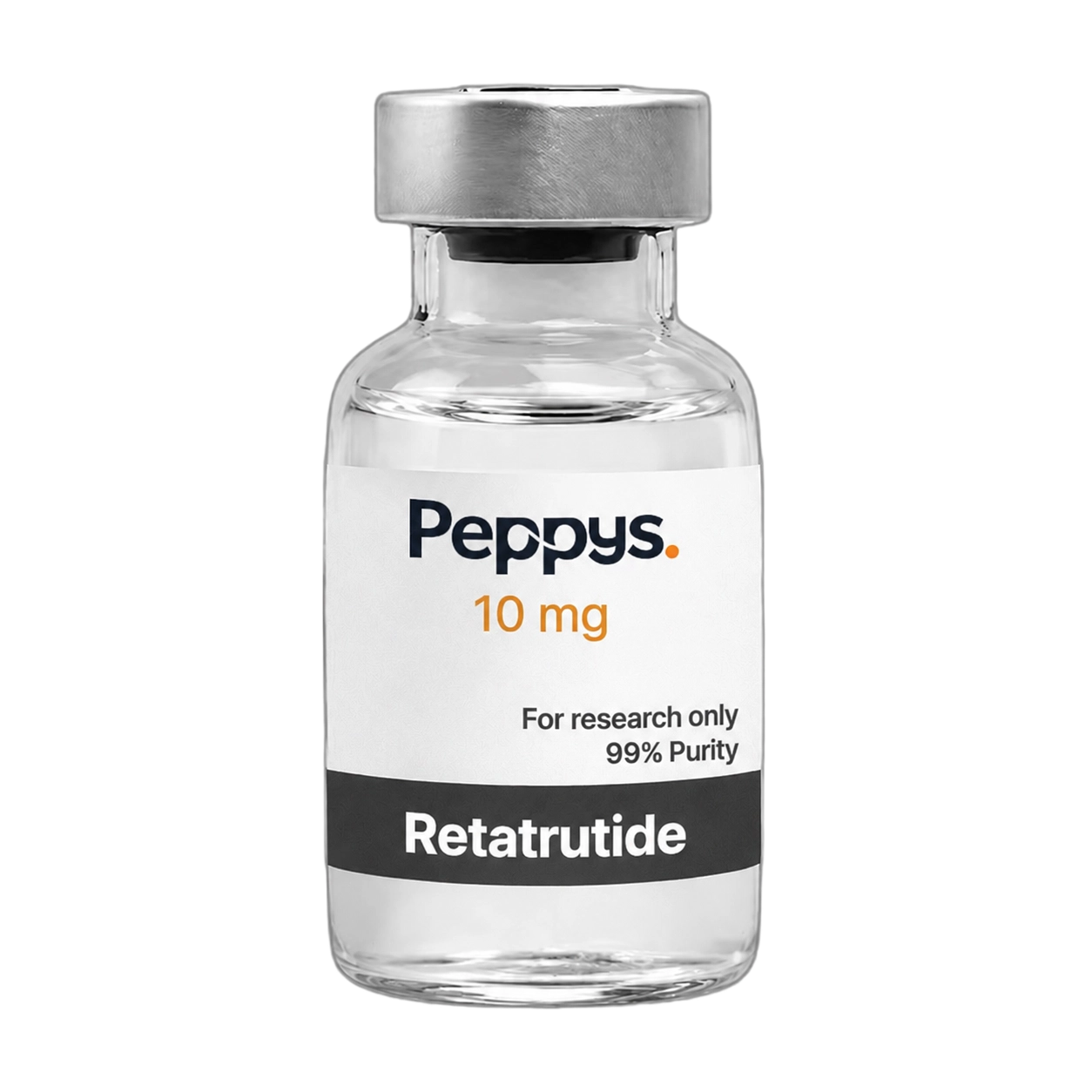
Quantities below reproduce their stated source context—label, human study, laboratory work or educational guide. They do not assess suitability, product equivalence or individual risk.
TRIUMPH phase 3 design
The default line reconstructs the 12 mg TRIUMPH phase 3 arm, starting at 2 mg and changing every four weeks through 4 mg, 6 mg and 9 mg.
Vial-aware arithmetic
Choose the vial quantity and BAC water first. The diagram and results below update for the selected 2 mg study quantity. Higher-strength vials may naturally land outside the 20-30 unit band.
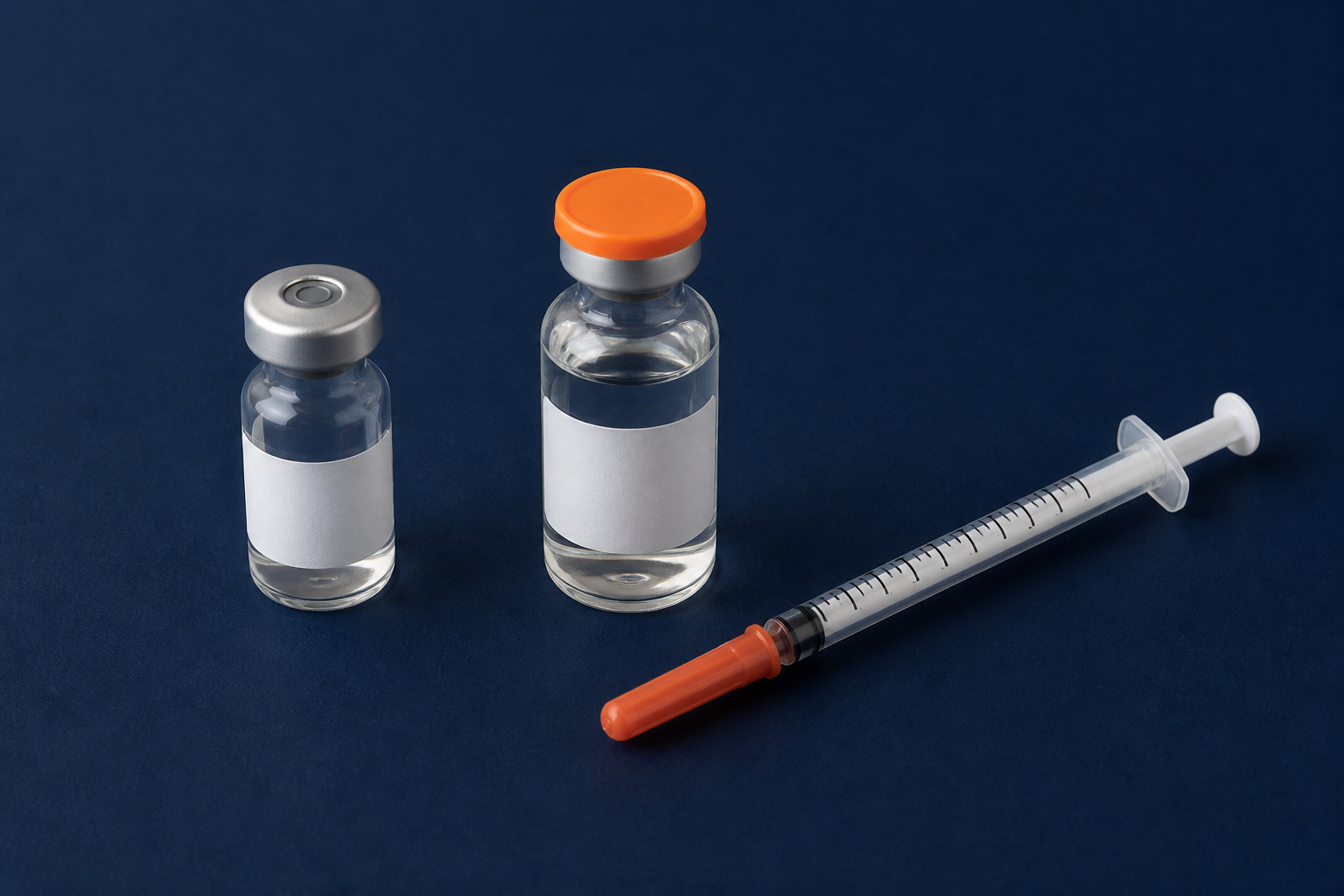
Basic example limit: 3 mL maximum. Check the actual vial and product-specific limits.
resulting U-100 draw
Shown in the diagram. Closest of these examples to 25 units.
resulting U-100 draw
resulting U-100 draw
Formula: draw units = selected mg × BAC mL ÷ vial mg × 100. The 20-30 unit band is a measurement reference, not a recommendation. Results are mathematical examples, not preparation instructions.
Each card states what the quantities are based on. A third-party or animal schedule is not a validated human dose.
Once-weekly phase 3 trial arms targeting 4 mg, 9 mg or 12 mg after a 2 mg start and four-week escalation steps
TRIUMPH-1 used the sequence 2 mg, 4 mg, 6 mg, 9 mg and 12 mg for the highest target arm. These were assigned research schedules, not prescribing instructions.
View sourceOnce-weekly subcutaneous trial arms targeting 1 mg, 4 mg, 8 mg or 12 mg, with lower starting-dose groups and dose escalation
Phase 2 randomised controlled study over 48 weeks; these were research arms rather than prescribing instructions.
View sourceWeekly use dominates, commonly beginning around 2 mg and clustering at 8-12 mg weekly during reported loss phases; maintenance reports span 0.5 mg weekly to 9-10 mg weekly
Split, every-three-to-five-day and daily schedules are fringe experiments, not trial conversions. The archive also contains a corrected 10 mg-every-five-days example that a refined file mistranscribed as 2 mg; raw/stacking-glp1s-a-contrarian-view.md:399 and dosing-summaries/01-retatrutide.md:18-53.
View sourceSubcutaneous weekly use dominates, commonly beginning around 2 mg and titrating stepwise (for example 2-4-6-8-9-10-12 mg, roughly four weeks per step) toward 8-12 mg, with 12 mg the reported maximum and effects said to "feel" around 6-8 mg; some run every 5-6 days tracking the ~6-day half-life, and low-dose responders report 1-2 mg weekly
Forum provenance from an authenticated archive with usernames omitted. Split, every-three-to-five-day and daily schedules are described as fringe experiments rather than trial conversions; the archive notes effects build over about eight weeks with weight loss starting near week twelve. Quantities conflict and are community provenance, not controlled dose finding.
View sourceRetatrutide activates three metabolic hormone receptors and remains an investigational medicine. Phase 3 topline results are available from the sponsor, while peer-reviewed phase 2 data remain important context.
The default line describes the assigned 12 mg target arm in TRIUMPH-1. Participants started at 2 mg and moved through 4 mg, 6 mg and 9 mg at four-week intervals before reaching 12 mg. Select a point to see the corresponding arithmetic, not to choose a personal quantity.
The examples hold BAC water at 1 mL, 2 mL or 3 mL and show the resulting U-100 draw for the selected study quantity. No basic example exceeds a 3 mL vial. They do not verify solubility, headspace, sterility, stability or whether the labelled vial quantity is accurate.
The phase 3 sponsor report and phase 2 paper should be read with their study populations, adverse events and discontinuations. Trial monitoring cannot be reproduced by a calculator.
A well-populated authenticated research-forum archive records subcutaneous retatrutide as a weekly compound, most often begun around 2 mg and titrated in roughly four-week steps toward 8-12 mg, with 12 mg described as the maximum and noticeable effects reported around 6-8 mg. A common variant doses every five to six days to track the roughly six-day half-life, while split, every-three-to-five-day and daily schedules are treated as fringe experiments. Low-dose responders and cagrilintide or tirzepatide stacking also appear. The same archive notes that effects build over about eight weeks with weight loss starting near week twelve, and records conflicting quantities. Usernames are omitted and figures are logged as community provenance without endorsement; these reports do not convert the trial schedule above.
Shared across protocols
Keep the universal checklist short. Product-specific labelling and source documentation always take priority over a general guide.
Use only a diluent appropriate to the research method and formulation.
View Peppys BAC waterUse a new sterile device for every entry. Source locally.
Source locallyPlan clean handling and immediate sharps disposal. Source locally.
Source locallyDo not apply a universal refrigerator rule. Follow the product, diluent and study documentation for temperature, light and expiry.
CDC injection-safety guidance calls for a new sterile needle and syringe for each injection and entry into a medication container.
Do not infer a post-mixing lifetime from BAC water alone. Discard material when identity, integrity or sterility is in doubt.