1 mL BAC
2.5 units
resulting U-100 draw
- Concentration
- 2 mg/mL
- BAC added
- 1 mL
An authorised peptide hormone for specific obstetric indications. Labelled intravenous and intramuscular use requires professional monitoring and is not a wellness protocol.
Quantities below reproduce their stated source context—label, human study, laboratory work or educational guide. They do not assess suitability, product equivalence or individual risk.
Community-reported mass quantities
Community-reported · not a validated scheduleVial arithmetic for directly reported 50-100 mcg subcutaneous quantities only. IU schedules and intranasal products are excluded because the archived IU-to-mass conversions conflict.
Vial-aware arithmetic
Choose the vial quantity and BAC water first. The diagram and results below update for the selected 50 mcg reported quantity. Higher-strength vials may naturally land outside the 20-30 unit band.
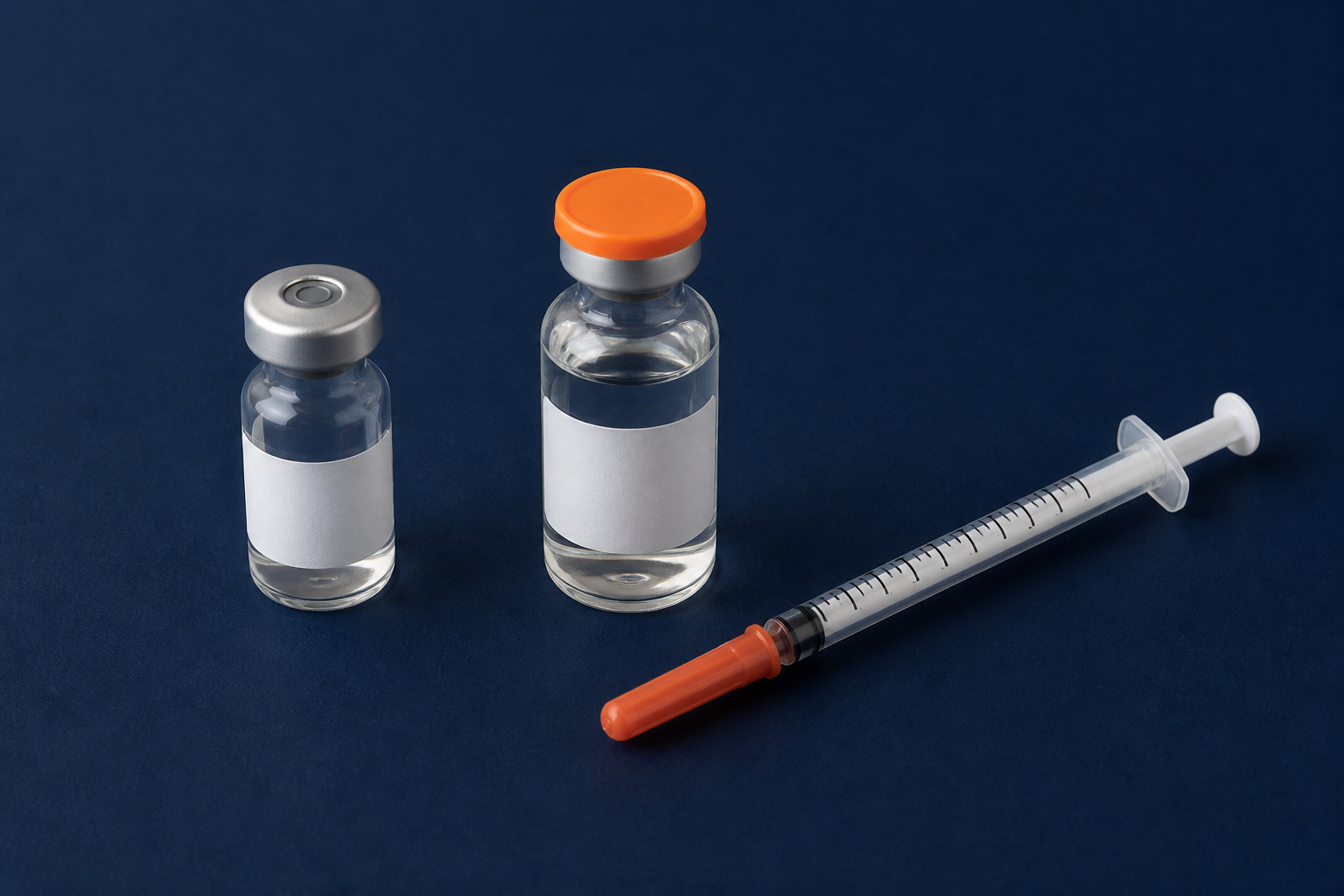
Basic example limit: 3 mL maximum. Check the actual vial and product-specific limits.
resulting U-100 draw
resulting U-100 draw
resulting U-100 draw
Shown in the diagram. Closest of these examples to 25 units.
Formula: draw units = selected mg × BAC mL ÷ vial mg × 100. The 20-30 unit band is a measurement reference, not a recommendation. Results are mathematical examples, not preparation instructions.
Each card states what the quantities are based on. A third-party or animal schedule is not a validated human dose.
Monitored intravenous infusion starts at no more than 1-2 milliunits/minute and may increase by no more than 1-2 milliunits/minute to uterine response
The label requires an infusion pump plus frequent uterine and fetal-heart monitoring, with immediate discontinuation for uterine hyperactivity or fetal distress.
View source10-40 units may be added to 1,000 mL infusion fluid, or 10 units may be given intramuscularly after delivery of the placenta
These indication-specific professional quantities are not transferable to intranasal, wellness or research-vial use.
View sourceThe spotlight states 24-40 IU intranasally per day divided into two or three administrations, while later reports use mass units over a very wide range
The channel's IU-to-mass paragraph contradicts itself by orders of magnitude. The archive schedule is not an authorised intranasal regimen and no conversion should be inferred from it; raw/peptide-education/pe-oxytocin.md:31-49 and 269-365.
View sourceSubcutaneous and intranasal onboarding reports cluster around 3 IU (about 50 mcg), titrating up to 5 IU (about 80 mcg) and 10 IU, with a reported community spread of roughly 50-250 mcg; 100 mcg is described as too strong by some and reduced to 50 mcg
Forum provenance with usernames omitted. Members insist on a substance-specific IU-to-mcg converter because the archive's own conversions are internally inconsistent, so IU and mcg figures are recorded as posted and not interconverted here. Poor reactions are noted, including a blood-pressure drop at 50 mcg subcutaneously and flushing at 100 mcg, and the subcutaneous and intranasal routes are kept separate.
View sourceIntranasal 24-32 IU daily, compounded as 8 IU or 16 IU sprays, or 50 IU sublingual daily taken about one hour before activity
This clinician compounding guide is dosed in International Units and runs heavier than typical community mcg practice. It reached the forum as an attached PDF, so it is community-sourced provenance rather than a regulatory label or an authorised intranasal product, and it is not interconverted to mass here.
View sourceAn authorised peptide hormone for specific obstetric indications. Labelled intravenous and intramuscular use requires professional monitoring and is not a wellness protocol.
The highest-confidence protocol source is authorised obstetric labelling, which specifies professional intravenous infusion or intramuscular use by indication. This site does not reproduce it as a self-use calculator.
Oxytocin is an approved drug for obstetric indications, so the intranasal and subcutaneous wellness use described in the forum is off-label. An authenticated research-forum archive converges on a low-dose, titrate-up approach that the community frames as one of the hardest peptides to dose, because clinical figures are stated in International Units while members work in mcg. Onboarding reports cluster around 3 IU (about 50 mcg), rising toward 5 IU and 10 IU, with a wider reported spread of roughly 50-250 mcg and poor reactions such as a blood-pressure drop or flushing at higher quantities. The archive also carries a clinician prescribers guide dosed in IU (intranasal 24-32 IU daily, or 50 IU sublingual), which runs heavier than typical community practice. Members stress the IU-to-mcg conversion is substance-specific and that the archive's own conversions are internally inconsistent, so no conversion is inferred here; usernames are omitted and routes are kept separate.
Intranasal behavioural findings are heterogeneous, and they do not establish broad psychiatric, social or wellness treatment.
Shared across protocols
Keep the universal checklist short. Product-specific labelling and source documentation always take priority over a general guide.
Select the labelled vial quantity used in the calculation.
View Peppys vialUse only a diluent appropriate to the research method and formulation.
View Peppys BAC waterUse a new sterile device for every entry. Source locally.
Source locallyPlan clean handling and immediate sharps disposal. Source locally.
Source locallyDo not apply a universal refrigerator rule. Follow the product, diluent and study documentation for temperature, light and expiry.
CDC injection-safety guidance calls for a new sterile needle and syringe for each injection and entry into a medication container.
Do not infer a post-mixing lifetime from BAC water alone. Discard material when identity, integrity or sterility is in doubt.