1 mL BAC
50 units
resulting U-100 draw
- Concentration
- 100 mg/mL
- BAC added
- 1 mL
Shown in the diagram. Closest of these examples to 25 units.
A cellular coenzyme used in heterogeneous infusion and metabolic research. Human evidence does not establish a standard subcutaneous research-vial protocol.
Quantities below reproduce their stated source context—label, human study, laboratory work or educational guide. They do not assess suitability, product equivalence or individual risk.
Community-reported schedule
Community-reported · not a validated scheduleCommunity-provenance subcutaneous NAD+ from an authenticated research forum - roughly 50-100 mg two to four times weekly, or a daily build-up reduced to maintenance. Intranasal use is shown separately. Community reports only, not validated.
Vial-aware arithmetic
Choose the vial quantity and BAC water first. The diagram and results below update for the selected 50 mg reported quantity. Higher-strength vials may naturally land outside the 20-30 unit band.
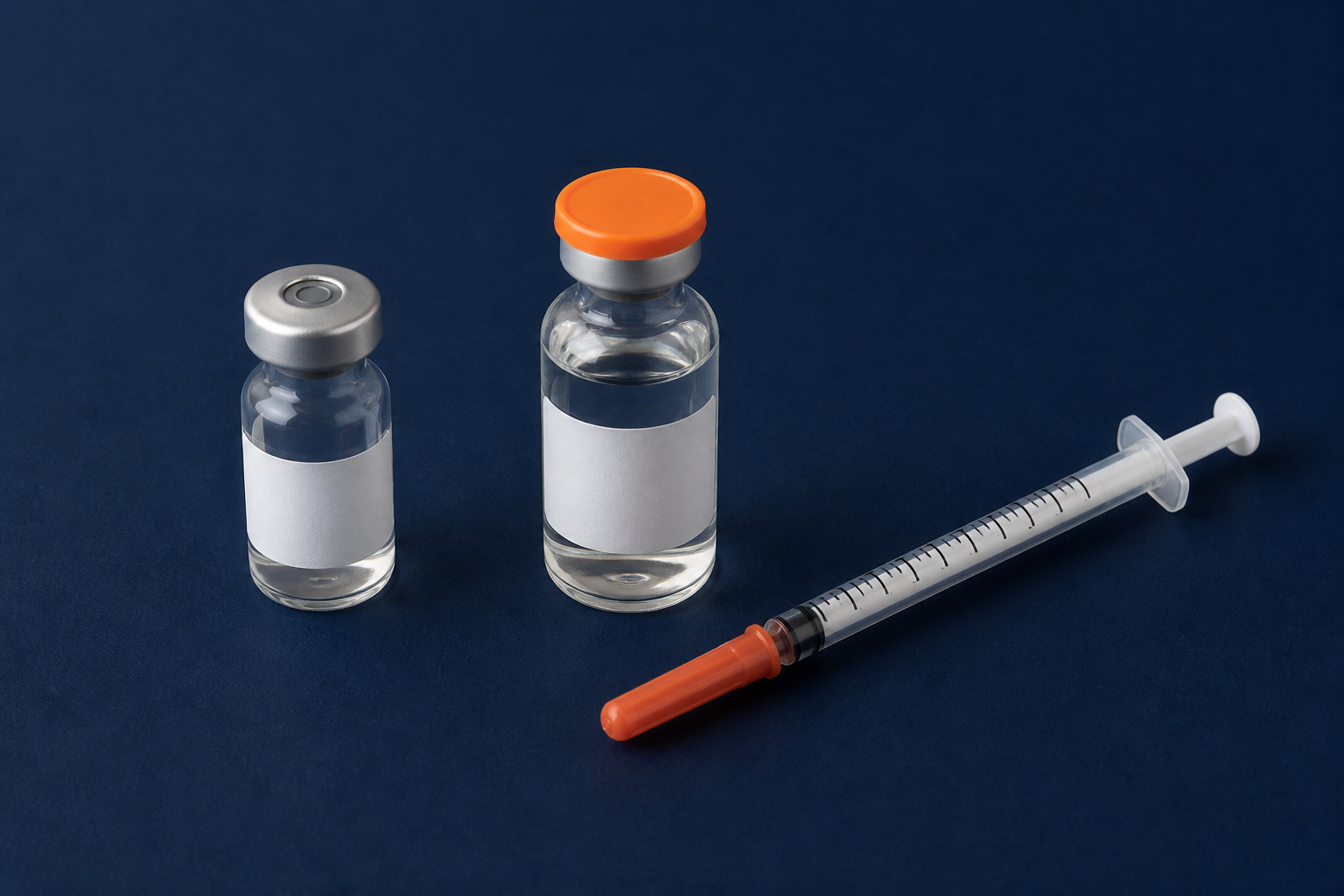
Basic example limit: 3 mL maximum. Check the actual vial and product-specific limits.
resulting U-100 draw
Shown in the diagram. Closest of these examples to 25 units.
resulting U-100 draw
resulting U-100 draw
This draw exceeds a 1 mL U-100 syringe.
Formula: draw units = selected mg × BAC mL ÷ vial mg × 100. The 20-30 unit band is a measurement reference, not a recommendation. Results are mathematical examples, not preparation instructions.
Each card states what the quantities are based on. A third-party or animal schedule is not a validated human dose.
50 mg daily in week 1, 75 mg in week 2 and 100 mg daily in weeks 3-16
The guide uses a subcutaneous route not established by the heterogeneous human infusion literature. It must not be treated as equivalent to monitored intravenous research.
View sourceThe spotlight lists 100 mg intranasally daily, up to 100 mg subcutaneously five days weekly, 500-1,000 mg intravenously, or 250-500 mg orally daily
Later channel guidance starts injected use at 20-50 mg and escalates slowly because rapid parenteral administration is repeatedly associated with unpleasant symptoms. Route equivalence and cycle length are not established; raw/peptide-education/pe-nad-plus.md:19-29, 476 and 763-778.
View sourceSubcutaneous reports cluster around 50-100 mg two to four times weekly, with some running up to 100 mg daily worked up over weeks and then reduced to 50 mg daily, and one report of roughly 100 mg on a 5-on/2-off schedule from a 500 mg vial reconstituted in 200 mL
Forum provenance with usernames omitted. The subcutaneous injection is widely described as stinging and is pH-adjusted, onset can take weeks, and many reports note no perceptible effect. Quantities conflict and are community provenance, not controlled human dose finding.
View sourceAn intranasal protocol built from a 1 g lyophilised vial targets 25 mg or 50 mg per day at roughly 10 mg per spray; one report found 50 mg intranasal too strong and reduced to 25 mg twice daily
The intranasal route is kept separate from the subcutaneous figures and is not interconverted. This is community-authored provenance rather than a validated or authorised regimen, with pH tuned toward the nasal mucosa to limit irritation.
View sourceA cellular coenzyme used in heterogeneous infusion and metabolic research. Human evidence does not establish a standard subcutaneous research-vial protocol.
The evidence review focuses on directly administered NAD+ and excludes studies that only test oral precursors. Available protocols are heterogeneous and route-specific.
An authenticated research-forum archive carries both an author-created intranasal nasal-spray protocol targeting 25 mg or 50 mg per day and community injectable practice clustering around 50-100 mg subcutaneously two to four times weekly, with a minority running it daily. Reported quantities conflict, the subcutaneous injection is repeatedly described as stinging and is pH-adjusted, and members note the effect can take weeks to appear while many perceive nothing. The intranasal and subcutaneous quantities are recorded separately and are not interconverted. Usernames are omitted and the figures are community provenance; the planner above reproduces the subcutaneous arithmetic without endorsing it.
Controlled outcome evidence, subcutaneous pharmacokinetics and a validated research-vial schedule remain absent.
Shared across protocols
Keep the universal checklist short. Product-specific labelling and source documentation always take priority over a general guide.
Select the labelled vial quantity used in the calculation.
View Peppys vialUse only a diluent appropriate to the research method and formulation.
View Peppys BAC waterUse a new sterile device for every entry. Source locally.
Source locallyPlan clean handling and immediate sharps disposal. Source locally.
Source locallyDo not apply a universal refrigerator rule. Follow the product, diluent and study documentation for temperature, light and expiry.
CDC injection-safety guidance calls for a new sterile needle and syringe for each injection and entry into a medication container.
Do not infer a post-mixing lifetime from BAC water alone. Discard material when identity, integrity or sterility is in doubt.