1 mL BAC
6 units
resulting U-100 draw
- Concentration
- 5 mg/mL
- BAC added
- 1 mL
A reproductive neuropeptide studied in specialist fertility research. Molecule length, bolus versus infusion and ovarian context materially change the protocol.
Quantities below reproduce their stated source context—label, human study, laboratory work or educational guide. They do not assess suitability, product equivalence or individual risk.
Community-reported schedule
Community-reported · not a validated scheduleA community-provenance subcutaneous kisspeptin-10 pattern from authenticated forum archives, favouring intermittent dosing to limit tolerance. Community reports only, not a validated or trial-verified schedule.
Vial-aware arithmetic
Choose the vial quantity and BAC water first. The diagram and results below update for the selected 300 mcg reported quantity. Higher-strength vials may naturally land outside the 20-30 unit band.
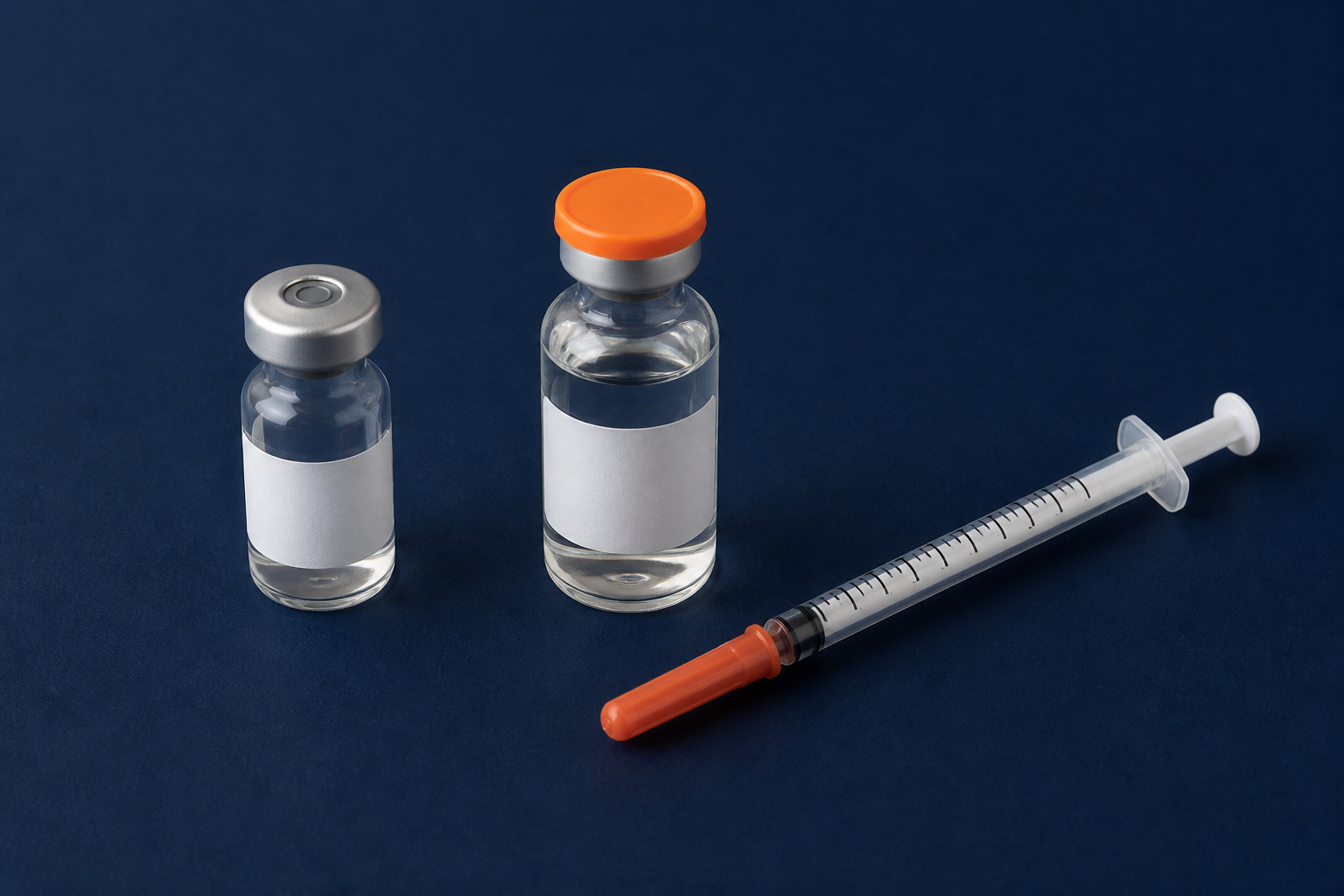
Basic example limit: 3 mL maximum. Check the actual vial and product-specific limits.
resulting U-100 draw
resulting U-100 draw
resulting U-100 draw
Shown in the diagram. Closest of these examples to 25 units.
Formula: draw units = selected mg × BAC mL ÷ vial mg × 100. The 20-30 unit band is a measurement reference, not a recommendation. Results are mathematical examples, not preparation instructions.
Each card states what the quantities are based on. A third-party or animal schedule is not a validated human dose.
A single subcutaneous kisspeptin-54 bolus at 1.6, 3.2, 6.4 or 12.8 nmol/kg after follicle monitoring
The study used ultrasound-defined timing to trigger oocyte maturation within a full IVF protocol.
View sourceEight-hour subcutaneous kisspeptin-54 infusion at 0.1, 0.3 or 1.0 nmol/kg/hour
This four-person physiology study used an infusion pump and serial hormone sampling.
View sourceSubcutaneous kisspeptin-10 reports range from about 65-100 mcg daily up to 1 mg three times a week, with reference charts anchoring 100 mcg nightly; many favour intermittent dosing such as every other day or two to three times weekly because tolerance is reported to build with daily use
Forum provenance from an authenticated archive with usernames omitted, describing the labelled kisspeptin-10 molecule rather than the kisspeptin-54 used in the cited trials. Reports conflict on both dose and cadence and on whether testosterone rises at all; the archive treats this as a poorly researched compound.
View sourceA reproductive neuropeptide studied in specialist fertility research. Molecule length, bolus versus infusion and ovarian context materially change the protocol.
The cited protocols are specialist reproductive studies with different molecular forms and delivery patterns. Those details are essential to interpreting any quantity.
There is no general-purpose schedule, and retail product identity may not match the kisspeptin form used in a cited trial.
An authenticated research-forum archive describes subcutaneous use of the labelled kisspeptin-10 molecule, kept distinct from the kisspeptin-54 in the cited fertility trials. Reported quantities conflict, spanning roughly 65-100 mcg daily up to 1 mg three times a week, while reference charts list 100 mcg nightly. The recurring theme is tolerance building rapidly with daily dosing, so many reports favour intermittent schedules such as every other day or two to three times weekly; luteinising-hormone rises are described more consistently than testosterone gains, and several reports note irritability. Usernames and post numbers are omitted and the figures are logged as community provenance without endorsement. The planner above reproduces the arithmetic of these reported quantities; it does not validate them.
The archive contains passing libido, pulse and reconstitution mentions but no actual kisspeptin quantity, frequency or cycle. No community schedule was added from those mentions (raw/peptide-education/pe-bremelanotide-pt141.md:954-967).
Shared across protocols
Keep the universal checklist short. Product-specific labelling and source documentation always take priority over a general guide.
Select the labelled vial quantity used in the calculation.
View Peppys vialUse only a diluent appropriate to the research method and formulation.
View Peppys BAC waterUse a new sterile device for every entry. Source locally.
Source locallyPlan clean handling and immediate sharps disposal. Source locally.
Source locallyDo not apply a universal refrigerator rule. Follow the product, diluent and study documentation for temperature, light and expiry.
CDC injection-safety guidance calls for a new sterile needle and syringe for each injection and entry into a medication container.
Do not infer a post-mixing lifetime from BAC water alone. Discard material when identity, integrity or sterility is in doubt.