1 mL BAC
5 units
resulting U-100 draw
- Concentration
- 5 mg/mL
- BAC added
- 1 mL
A ghrelin-receptor agonist with early human pharmacology and an intravenous phase 2 postoperative study. Neither establishes a routine subcutaneous wellness protocol.
Quantities below reproduce their stated source context—label, human study, laboratory work or educational guide. They do not assess suitability, product equivalence or individual risk.
Community-reported schedule
Community-reported · not a validated scheduleA community-provenance subcutaneous pattern from authenticated forum archives - roughly 200-300 mcg daily, usually paired with a GHRH. Community reports only, not a validated or trial-verified schedule.
Vial-aware arithmetic
Choose the vial quantity and BAC water first. The diagram and results below update for the selected 250 mcg reported quantity. Higher-strength vials may naturally land outside the 20-30 unit band.
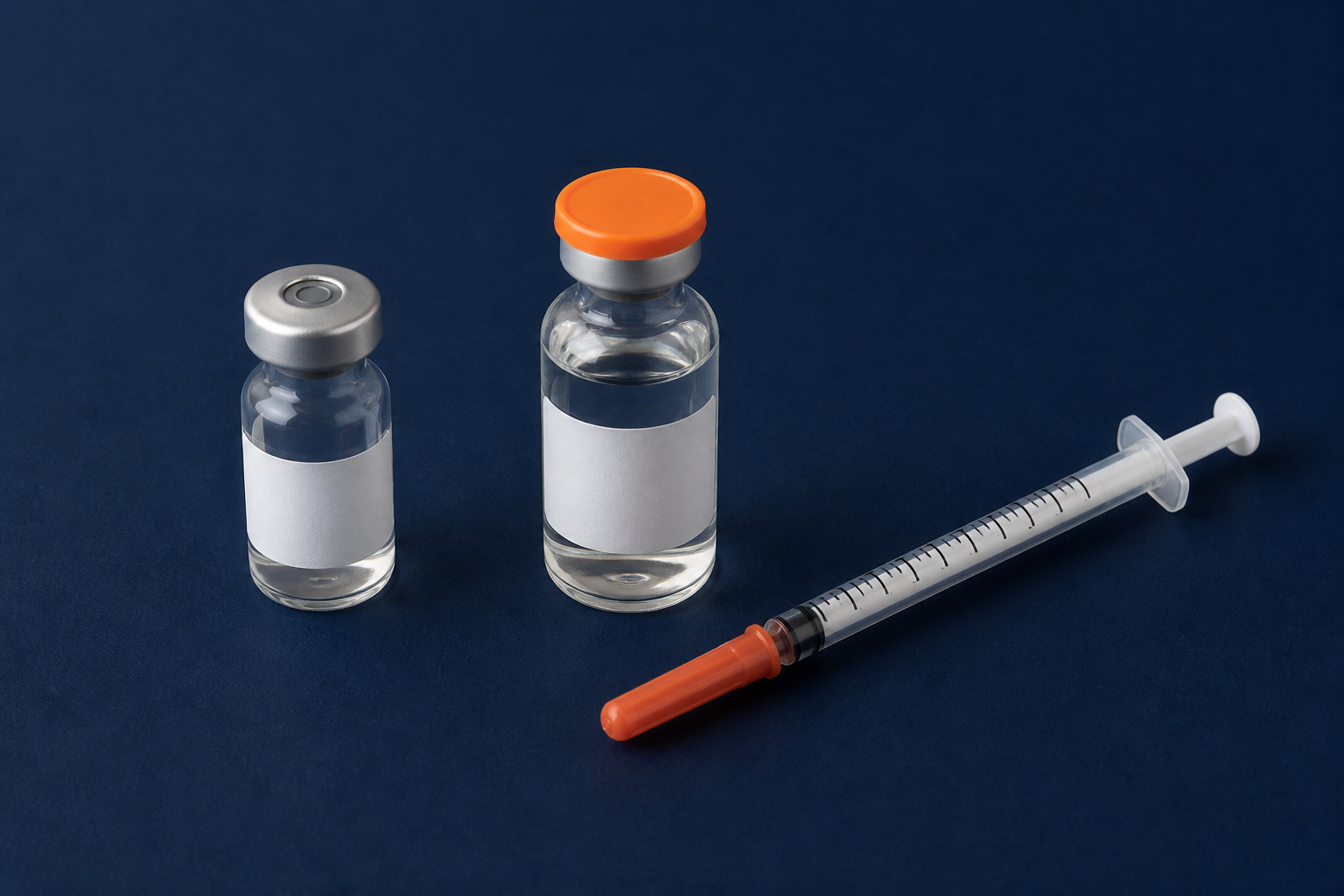
Basic example limit: 3 mL maximum. Check the actual vial and product-specific limits.
resulting U-100 draw
resulting U-100 draw
resulting U-100 draw
Shown in the diagram. Closest of these examples to 25 units.
Formula: draw units = selected mg × BAC mL ÷ vial mg × 100. The 20-30 unit band is a measurement reference, not a recommendation. Results are mathematical examples, not preparation instructions.
Each card states what the quantities are based on. A third-party or animal schedule is not a validated human dose.
0.03 mg/kg by intravenous infusion twice daily from postoperative day 1 through day 7 or discharge
This was an inpatient postoperative ileus study and did not establish subcutaneous or long-term use.
View sourceSingle 15-minute intravenous infusions across five dose-escalation cohorts
This pharmacology experiment measured short-term growth-hormone release rather than a clinical outcome.
View sourceThe spotlight states 200-300 mcg subcutaneously per day, often split into two or three administrations for 8-12 weeks followed by four weeks off
Other posts interpret 200-300 mcg as a per-administration amount and an expert says cycling may not be necessary. The archive therefore contains a material total-daily-versus-per-dose ambiguity; raw/peptide-education/pe-ipamorelin.md:25-27 and 80-116.
View sourceSubcutaneous reports cluster around 200-300 mcg daily, commonly split into a morning and evening dose and paired with a GHRH such as tesamorelin or CJC-1295 no-DAC; many run five days on and two off in roughly eight-week cycles, and reference charts list 200 mcg five days a week or 300 mcg daily
Forum provenance from an authenticated archive with usernames omitted. Ipamorelin is the GHRP half of the pairing and is kept separate from the GHRH it is combined with; reports conflict over whether 200-300 mcg is a total-daily or per-administration amount, and the archive states human dosing is not established.
View sourceA ghrelin-receptor agonist with early human pharmacology and an intravenous phase 2 postoperative study. Neither establishes a routine subcutaneous wellness protocol.
The page reports the actual intravenous study designs and makes the route mismatch visible instead of translating them into subcutaneous units.
An authenticated research-forum archive records subcutaneous ipamorelin clustering around 200-300 mcg daily, frequently divided between morning and evening and almost always paired with a growth-hormone-releasing hormone such as tesamorelin or CJC-1295 no-DAC. Reports conflict over whether 200-300 mcg is a total daily amount or a per-administration dose, and cadence ranges from continuous use to eight-week blocks dosed five days on and two off. Usernames and post numbers are omitted and the quantities are logged as community provenance without endorsement. The planner above reproduces the arithmetic of these reported quantities; it does not validate them.
A validated outpatient indication, subcutaneous exposure, long-term safety and clinical benefit are not established.
Shared across protocols
Keep the universal checklist short. Product-specific labelling and source documentation always take priority over a general guide.
Select the labelled vial quantity used in the calculation.
View Peppys vialUse only a diluent appropriate to the research method and formulation.
View Peppys BAC waterUse a new sterile device for every entry. Source locally.
Source locallyPlan clean handling and immediate sharps disposal. Source locally.
Source locallyDo not apply a universal refrigerator rule. Follow the product, diluent and study documentation for temperature, light and expiry.
CDC injection-safety guidance calls for a new sterile needle and syringe for each injection and entry into a medication container.
Do not infer a post-mixing lifetime from BAC water alone. Discard material when identity, integrity or sterility is in doubt.