1 mL BAC
5 units
resulting U-100 draw
- Concentration
- 1 mg/mL
- BAC added
- 1 mL
A long-acting IGF-1 research analogue used mainly in laboratory models. Clinical evidence for approved recombinant human IGF-1 does not transfer to LR3.
Quantities below reproduce their stated source context—label, human study, laboratory work or educational guide. They do not assess suitability, product equivalence or individual risk.
Community-reported schedule
Community-reported · not a validated scheduleA community-provenance subcutaneous line from forum logs - clustering at 50 mcg around training in short 20-day to 4-6 week cycles, reconstituted in acetic-acid water. Community reports only, not a validated schedule.
Vial-aware arithmetic
Choose the vial quantity and BAC water first. The diagram and results below update for the selected 50 mcg reported quantity. Higher-strength vials may naturally land outside the 20-30 unit band.
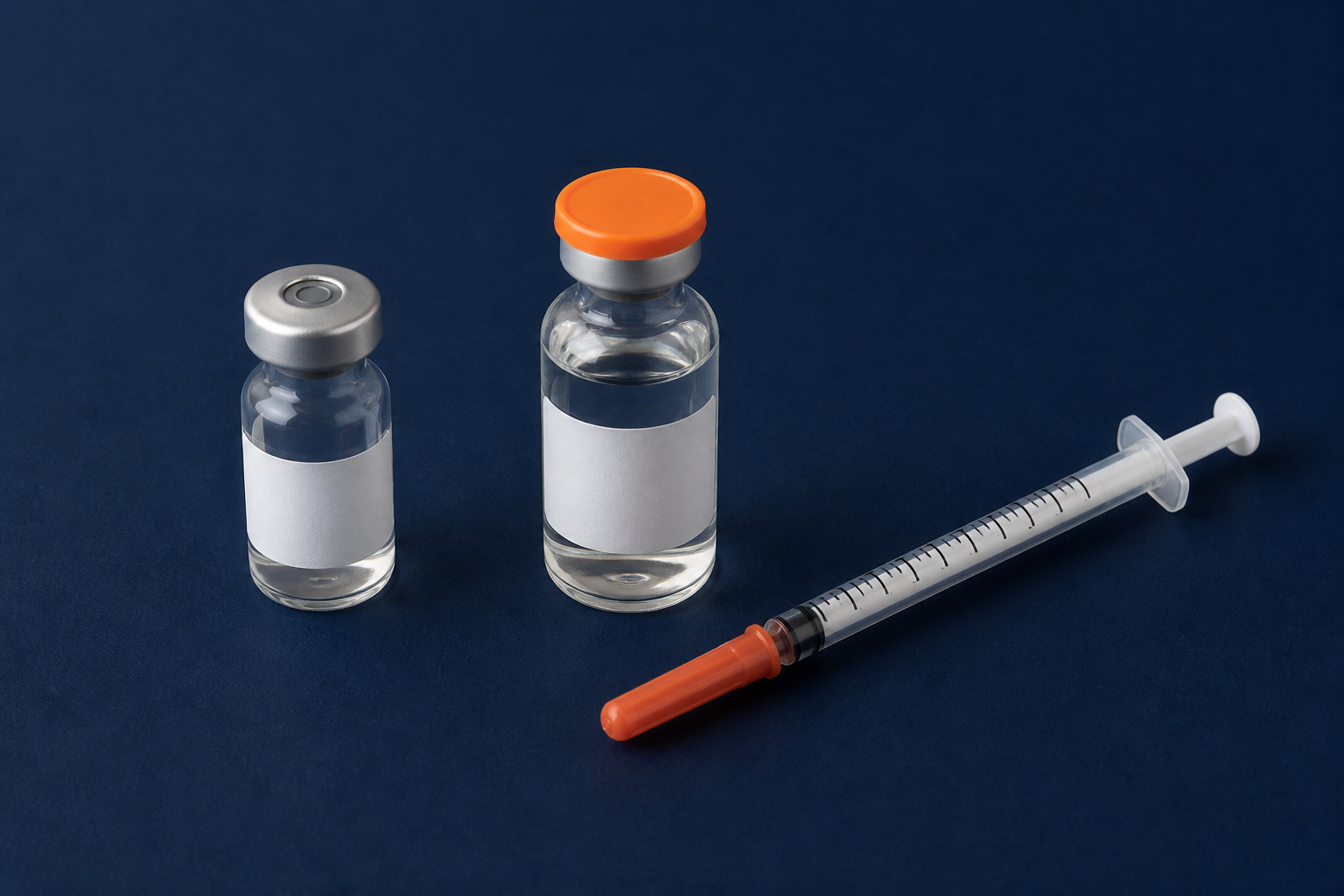
Basic example limit: 3 mL maximum. Check the actual vial and product-specific limits.
resulting U-100 draw
resulting U-100 draw
resulting U-100 draw
Shown in the diagram. Closest of these examples to 25 units.
Formula: draw units = selected mg × BAC mL ÷ vial mg × 100. The 20-30 unit band is a measurement reference, not a recommendation. Results are mathematical examples, not preparation instructions.
Each card states what the quantities are based on. A third-party or animal schedule is not a validated human dose.
20 mcg daily in weeks 1-2, 40 mcg in weeks 3-4 and 50 mcg in weeks 5-8
No controlled human LR3 study validates this schedule. Evidence for authorised mecasermin or native IGF-1 is not molecularly interchangeable.
View sourceThe best-documented archive experiment used 50 mcg subcutaneously once daily for two weeks, while another used 100 mcg daily for about one month
These are uncontrolled N-of-1 experiments, not human dose-finding evidence. A lipid-marker interpretation from the first experiment was later withdrawn by its author; raw/discussions/disc-lipid-management.md:2704-2707, 3427-3461 and 4013-4017.
View sourceSubcutaneous quantities converge tightly on 50 mcg daily (reported range 50-100 mcg), dosed around training in short cycles of about 20 days to 4-6 weeks, with some running five days on and two off; the most-repeated preparation note is to reconstitute in acetic-acid water rather than bacteriostatic water to preserve potency
Forum provenance from an authenticated archive with usernames omitted. Members warn that higher doses and longer durations speed receptor downregulation, so quantities and cycles are kept low and short; reports note extreme on-cycle fatigue and one cardiac-event anecdote. Community provenance, not controlled human dose finding; the subcutaneous route and acetic-acid preparation are preserved rather than interconverted.
View sourceA long-acting IGF-1 research analogue used mainly in laboratory models. Clinical evidence for approved recombinant human IGF-1 does not transfer to LR3.
The protocol boundary is molecular identity. Evidence from mecasermin labels or native IGF-1 cannot be used to manufacture a human LR3 schedule.
An authenticated research-forum archive records subcutaneous self-experiments converging tightly on 50 mcg daily, within a 50-100 mcg range, dosed around training in short cycles of roughly 20 days to four to six weeks. The most-repeated preparation note is to reconstitute IGF-1 LR3 in acetic-acid water rather than bacteriostatic water to preserve potency, and members warn that higher doses or longer durations speed receptor downregulation, keeping quantities low and cycles short. Reports note extreme on-cycle fatigue and one cardiac-event anecdote; usernames are omitted and figures are logged as community provenance without endorsement. The planner above reproduces the arithmetic of these reported quantities; it does not validate them.
Human pharmacokinetics, safety, dose-response, long-term growth effects and clinical benefit are unknown.
Shared across protocols
Keep the universal checklist short. Product-specific labelling and source documentation always take priority over a general guide.
Select the labelled vial quantity used in the calculation.
View Peppys vialUse only a diluent appropriate to the research method and formulation.
View Peppys BAC waterUse a new sterile device for every entry. Source locally.
Source locallyPlan clean handling and immediate sharps disposal. Source locally.
Source locallyDo not apply a universal refrigerator rule. Follow the product, diluent and study documentation for temperature, light and expiry.
CDC injection-safety guidance calls for a new sterile needle and syringe for each injection and entry into a medication container.
Do not infer a post-mixing lifetime from BAC water alone. Discard material when identity, integrity or sterility is in doubt.