1 mL BAC
2 units
resulting U-100 draw
- Concentration
- 50 mg/mL
- BAC added
- 1 mL
A copper-binding tripeptide investigated mainly in laboratory, wound and topical cosmetic contexts. Evidence does not establish an injectable human regimen.
Quantities below reproduce their stated source context—label, human study, laboratory work or educational guide. They do not assess suitability, product equivalence or individual risk.
Community-reported schedule
Community-reported · not a validated scheduleTwo community-provenance subcutaneous lines - an Anela-derived daily dose co-formulated with BPC-157 near 1-1.75 mg, and an educational 50 mg-vial titration to 2 mg. Community reports only, not a validated or trial-verified schedule.
Vial-aware arithmetic
Choose the vial quantity and BAC water first. The diagram and results below update for the selected 1 mg reported quantity. Higher-strength vials may naturally land outside the 20-30 unit band.
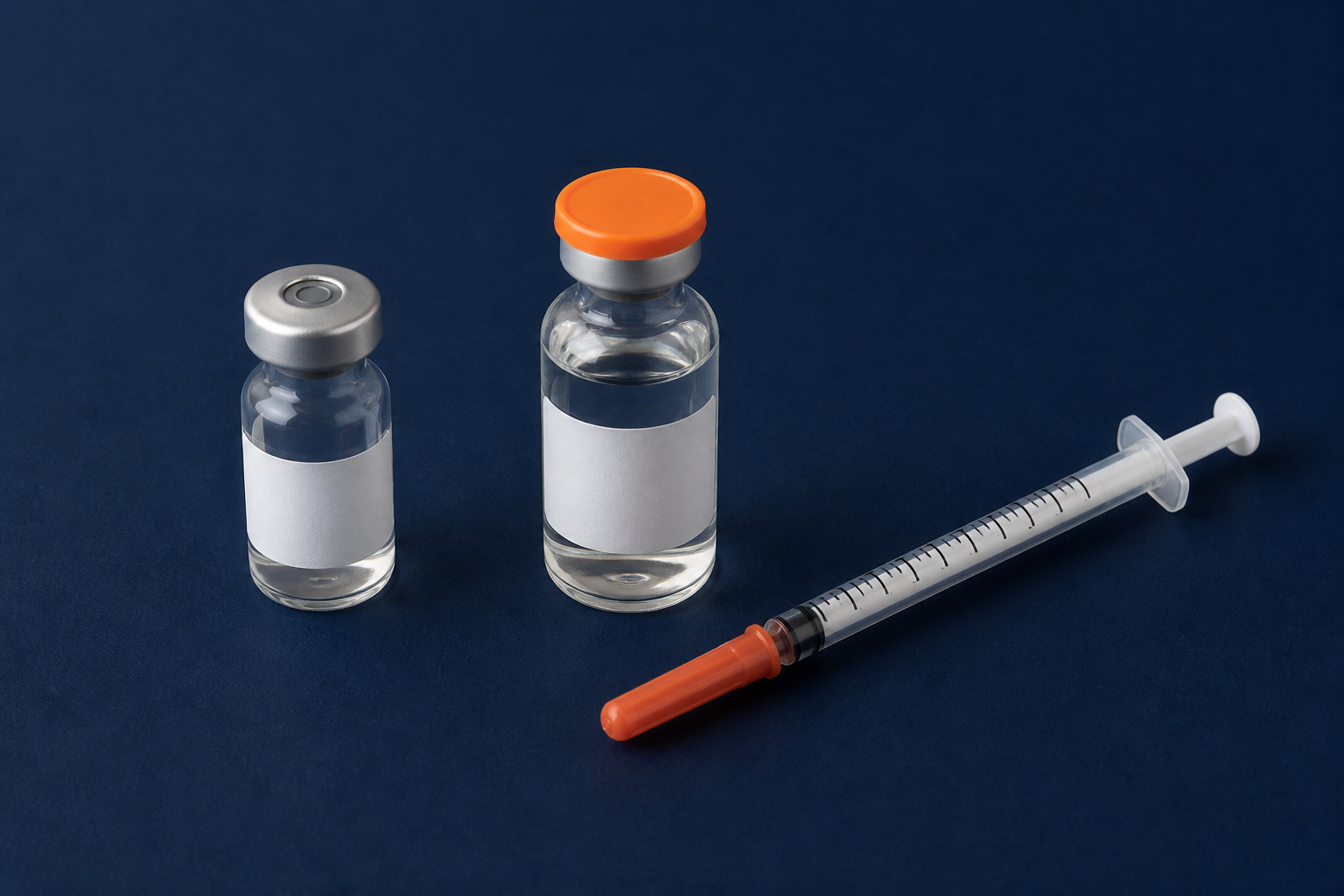
Basic example limit: 3 mL maximum. Check the actual vial and product-specific limits.
resulting U-100 draw
resulting U-100 draw
resulting U-100 draw
Shown in the diagram. Closest of these examples to 25 units.
Formula: draw units = selected mg × BAC mL ÷ vial mg × 100. The 20-30 unit band is a measurement reference, not a recommendation. Results are mathematical examples, not preparation instructions.
Each card states what the quantities are based on. A third-party or animal schedule is not a validated human dose.
Formulations and exposure varied substantially across the cited literature
No evidence-backed injectable schedule is presented because the reviewed literature does not establish one.
View source1 mg per administration in weeks 1-4, 1.5 mg in weeks 5-8 and 2 mg in weeks 9-12, five days per week
This proposed subcutaneous schedule is not validated by the topical, wound or laboratory human literature and is shown only as low-confidence provenance.
View sourceThe spotlight states 2-5 mg per subcutaneous administration and 1 gram per ounce topically, while common injection reports include 2 mg Monday-Friday
The channel itself says useful human subcutaneous dosing trials are absent. Daily reports extend above the commercial guide and blend quantities vary substantially; raw/peptide-education/pe-ghk-cu.md:24-31, 1047-1053 and 2605-2609.
View sourceA flagship injectable protocol reconstitutes 50 mg GHK-Cu with 10 mg BPC-157 in 3 mL bacteriostatic water and doses roughly 1-1.75 mg GHK-Cu subcutaneously per injection (the author prefers 1.75 mg, about 10.5 units); community practice sits around 1-3 mg daily, with a cited upper limit near 33 mg daily, cycled about six months with daily zinc; a separate 2 percent topical serum is used twice daily
Forum provenance from an authenticated archive with usernames omitted. Co-formulation with BPC-157 is treated as near-mandatory because pure GHK-Cu causes severe injection-site reactions. The injectable, topical serum and cream routes are kept separate rather than interconverted, and quantities conflict. Community provenance, not controlled human dose finding.
View sourceGHK-Cu is discussed across cell, animal, wound and cosmetic research. Route and formulation matter, and topical findings cannot be converted into an injection protocol.
RetaCalc deliberately withholds an injectable studied-regimen table until suitable controlled human evidence supports one.
An authenticated research-forum archive, including an Official Anela protocol, records a subcutaneous injectable that reconstitutes 50 mg GHK-Cu with 10 mg BPC-157 in 3 mL and doses roughly 1-1.75 mg per injection, with the co-formulated BPC-157 treated as near-mandatory to control severe injection-site reactions. Community practice is described around 1-3 mg daily, cycled about six months with daily zinc, alongside a separate 2 percent topical serum applied twice daily. The archive keeps the injectable, serum and cream routes separate and records conflicting quantities up to a cited 33 mg daily ceiling; usernames are omitted and figures are logged as community provenance without endorsement. The planner above reproduces the arithmetic of the injectable reports only and does not validate them.
Shared across protocols
Keep the universal checklist short. Product-specific labelling and source documentation always take priority over a general guide.
Select the labelled vial quantity used in the calculation.
View Peppys vialUse only a diluent appropriate to the research method and formulation.
View Peppys BAC waterUse a new sterile device for every entry. Source locally.
Source locallyPlan clean handling and immediate sharps disposal. Source locally.
Source locallyDo not apply a universal refrigerator rule. Follow the product, diluent and study documentation for temperature, light and expiry.
CDC injection-safety guidance calls for a new sterile needle and syringe for each injection and entry into a medication container.
Do not infer a post-mixing lifetime from BAC water alone. Discard material when identity, integrity or sterility is in doubt.