1 mL BAC
30 units
resulting U-100 draw
- Concentration
- 10 mg/mL
- BAC added
- 1 mL
Shown in the diagram. Closest of these examples to 25 units.
A once-weekly selective amylin receptor agonist in phase 3 development, with published phase 2 arms spanning fixed and escalated 1 mg to 9 mg targets.
Quantities below reproduce their stated source context—label, human study, laboratory work or educational guide. They do not assess suitability, product equivalence or individual risk.
Published phase 2 design
The simplified line uses one maximum per arm. The 9 mg line reproduces the published 3 mg to 6 mg to 9 mg progression with four weeks at each lower stage.
Vial-aware arithmetic
Choose the vial quantity and BAC water first. The diagram and results below update for the selected 3 mg study quantity. Higher-strength vials may naturally land outside the 20-30 unit band.
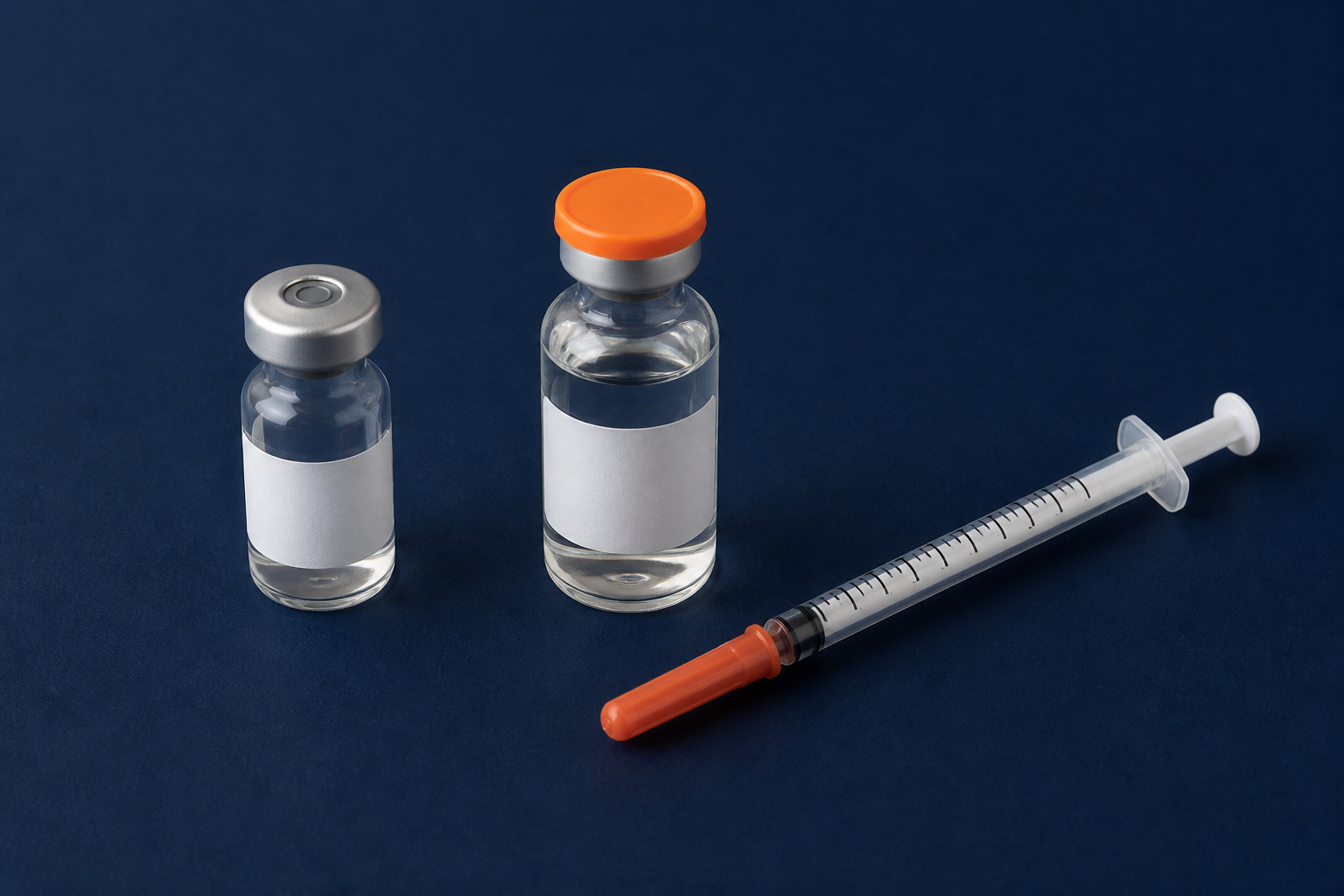
Basic example limit: 3 mL maximum. Check the actual vial and product-specific limits.
resulting U-100 draw
Shown in the diagram. Closest of these examples to 25 units.
resulting U-100 draw
resulting U-100 draw
Formula: draw units = selected mg × BAC mL ÷ vial mg × 100. The 20-30 unit band is a measurement reference, not a recommendation. Results are mathematical examples, not preparation instructions.
Each card states what the quantities are based on. A third-party or animal schedule is not a validated human dose.
Once-weekly subcutaneous phase 2 arms at 1 mg, 3 mg, 6 mg or 9 mg, plus 6-to-9 mg and 3-to-6-to-9 mg escalation arms
The 48-week randomized study compared fixed and escalated research arms with placebo; it is not prescribing guidance.
View sourceA once-weekly selective amylin receptor agonist in phase 3 development, with published phase 2 arms spanning fixed and escalated 1 mg to 9 mg targets.
The protocol summary comes from a published 48-week randomized phase 2 trial and is presented as fixed and escalated study arms.
Phase 3 outcomes, authorised labelling, long-term benefit-risk and equivalence to unregulated vials remain unresolved.
The reviewed online research community material repeats the 1 mg, 3 mg, 6 mg and 9 mg phase 2 arms and the 3-to-6-to-9 mg escalation design. It does not contain a distinct community-use schedule, so the structured protocol remains anchored to the published study.
Shared across protocols
Keep the universal checklist short. Product-specific labelling and source documentation always take priority over a general guide.
Select the labelled vial quantity used in the calculation.
View Peppys vialUse only a diluent appropriate to the research method and formulation.
View Peppys BAC waterUse a new sterile device for every entry. Source locally.
Source locallyPlan clean handling and immediate sharps disposal. Source locally.
Source locallyDo not apply a universal refrigerator rule. Follow the product, diluent and study documentation for temperature, light and expiry.
CDC injection-safety guidance calls for a new sterile needle and syringe for each injection and entry into a medication container.
Do not infer a post-mixing lifetime from BAC water alone. Discard material when identity, integrity or sterility is in doubt.