1 mL BAC
2 units
resulting U-100 draw
- Concentration
- 5 mg/mL
- BAC added
- 1 mL
A small neuropeptide investigated in older and heterogeneous sleep experiments. The literature does not support a current standard administration protocol.
Quantities below reproduce their stated source context—label, human study, laboratory work or educational guide. They do not assess suitability, product equivalence or individual risk.
Community-reported schedule
Community-reported · not a validated scheduleA community-provenance subcutaneous line from forum reports - starting near 100 mcg in the evening and titrated toward 250-500 mcg. Community reports only; the cited human studies used far larger IV morning doses, not reproduced here.
Vial-aware arithmetic
Choose the vial quantity and BAC water first. The diagram and results below update for the selected 100 mcg reported quantity. Higher-strength vials may naturally land outside the 20-30 unit band.
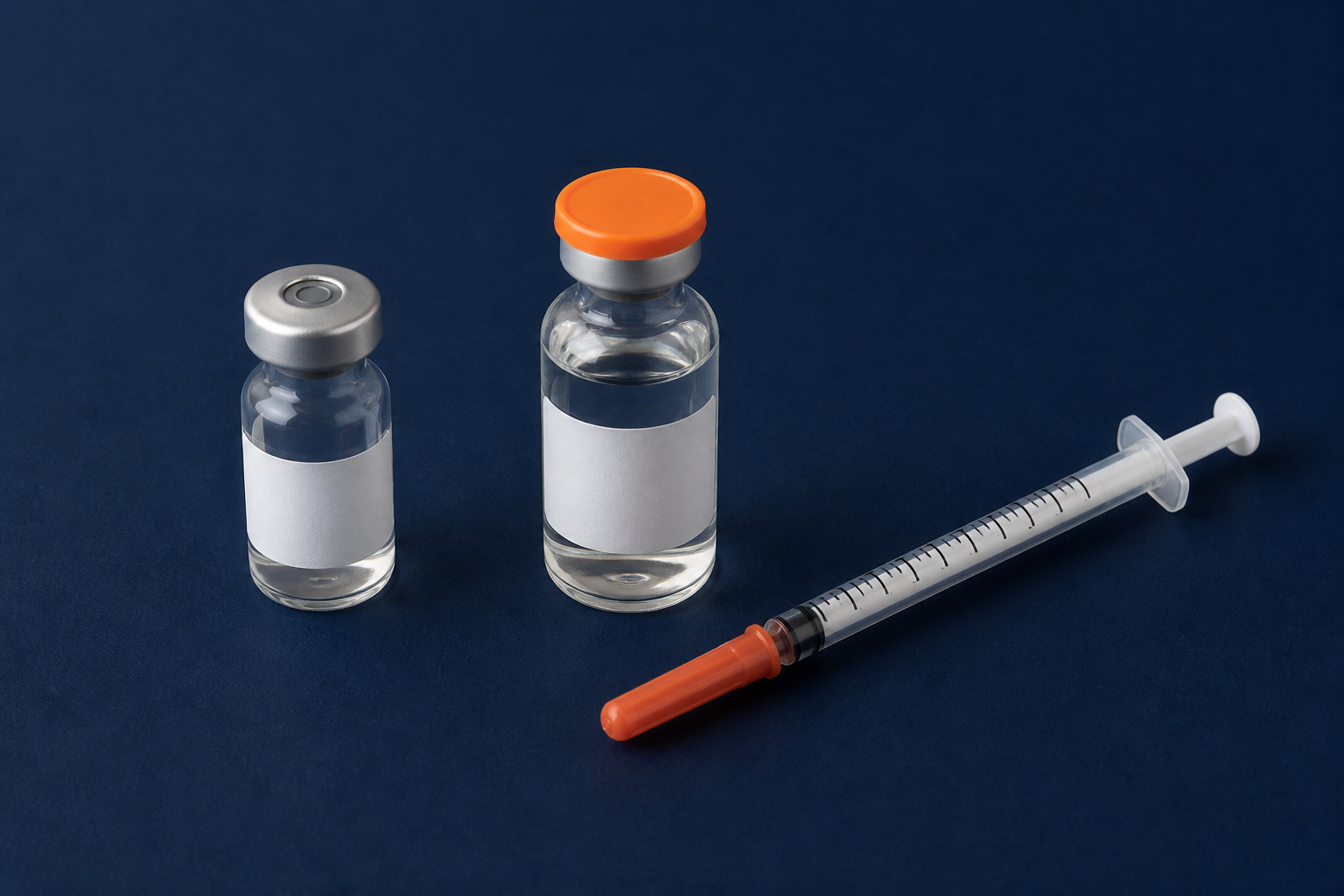
Basic example limit: 3 mL maximum. Check the actual vial and product-specific limits.
resulting U-100 draw
resulting U-100 draw
resulting U-100 draw
Shown in the diagram. Closest of these examples to 25 units.
Formula: draw units = selected mg × BAC mL ÷ vial mg × 100. The 20-30 unit band is a measurement reference, not a recommendation. Results are mathematical examples, not preparation instructions.
Each card states what the quantities are based on. A third-party or animal schedule is not a validated human dose.
100 mcg daily in week 1, 150 mcg in week 2, 200 mcg in week 3 and 250-300 mcg daily in weeks 4-8
This schedule is not reproduced by a modern controlled human trial. Historical DSIP studies were small and heterogeneous, so confidence remains very low.
View sourceReported quantities cluster around 100-400 mcg near sleep, including 250-500 mcg nightly and 300 mcg subcutaneously nightly
Cycling varies from three times weekly with month-long breaks to 30 days on and 30 days off. Several users report no measurable benefit, and one moved use before 6 PM because it felt stimulating; raw/peptide-education/pe-tesamorelin.md:2663-2728 and raw/bioregulators/bio-pinealon.md:289-293.
View sourceSubcutaneous or intranasal quantities cluster around 100 mcg in the evening titrated toward 250-500 mcg, dosed one to two hours before bed or as early as 5-6 PM because it can feel stimulating; a contested minority runs mg-range subcutaneous doses of roughly 1.5-2 mg (occasionally 5 mg) to cross a reported non-response threshold
Forum provenance from an authenticated archive with usernames omitted. The archive flags a direct conflict between practice and the cited human studies, which used about 25 nmol/kg intravenously (roughly 1.7 mg) in the morning, and records highly variable response with many reporting no effect even above 450 mcg. Community provenance, not controlled human dose finding; subcutaneous, intranasal and intravenous quantities are kept separate.
View sourceA small neuropeptide investigated in older and heterogeneous sleep experiments. The literature does not support a current standard administration protocol.
The evidence level reflects historical human exposure, but the absence of a coherent replicated schedule keeps confidence low.
An authenticated research-forum archive records subcutaneous or intranasal quantities clustering around 100 mcg in the evening, titrated toward roughly 250-500 mcg, dosed one to two hours before bed or earlier because some report a stimulating effect. The same archive flags a direct conflict with the cited human studies, which used about 25 nmol/kg intravenously in the morning (roughly 1.7 mg), and a minority who run mg-range subcutaneous doses to cross a reported non-response threshold. Response is described as highly variable, with many reporting no measurable benefit even above 450 mcg; usernames are omitted and figures are logged as community provenance without endorsement. The planner above reproduces the arithmetic of the low-dose subcutaneous reports only and does not validate them.
A validated indication, modern controlled efficacy, optimal route and product equivalence are not established.
Shared across protocols
Keep the universal checklist short. Product-specific labelling and source documentation always take priority over a general guide.
Select the labelled vial quantity used in the calculation.
View Peppys vialUse only a diluent appropriate to the research method and formulation.
View Peppys BAC waterUse a new sterile device for every entry. Source locally.
Source locallyPlan clean handling and immediate sharps disposal. Source locally.
Source locallyDo not apply a universal refrigerator rule. Follow the product, diluent and study documentation for temperature, light and expiry.
CDC injection-safety guidance calls for a new sterile needle and syringe for each injection and entry into a medication container.
Do not infer a post-mixing lifetime from BAC water alone. Discard material when identity, integrity or sterility is in doubt.