1 mL BAC
10 units
resulting U-100 draw
- Concentration
- 20 mg/mL
- BAC added
- 1 mL
A short peptide bioregulator marketed for cartilage-related claims. Internationally indexed controlled human evidence is too sparse to establish a protocol.
Quantities below reproduce their stated source context—label, human study, laboratory work or educational guide. They do not assess suitability, product equivalence or individual risk.
Community-reported schedule
Community-reported · not a validated scheduleCommunity-provenance subcutaneous bioregulator dosing from an authenticated research forum, about 1-2 mg once daily in roughly 20-day cycles, with some reports titrating to 5 mg. Forum reports only, not a validated schedule.
Vial-aware arithmetic
Choose the vial quantity and BAC water first. The diagram and results below update for the selected 2 mg reported quantity. Higher-strength vials may naturally land outside the 20-30 unit band.
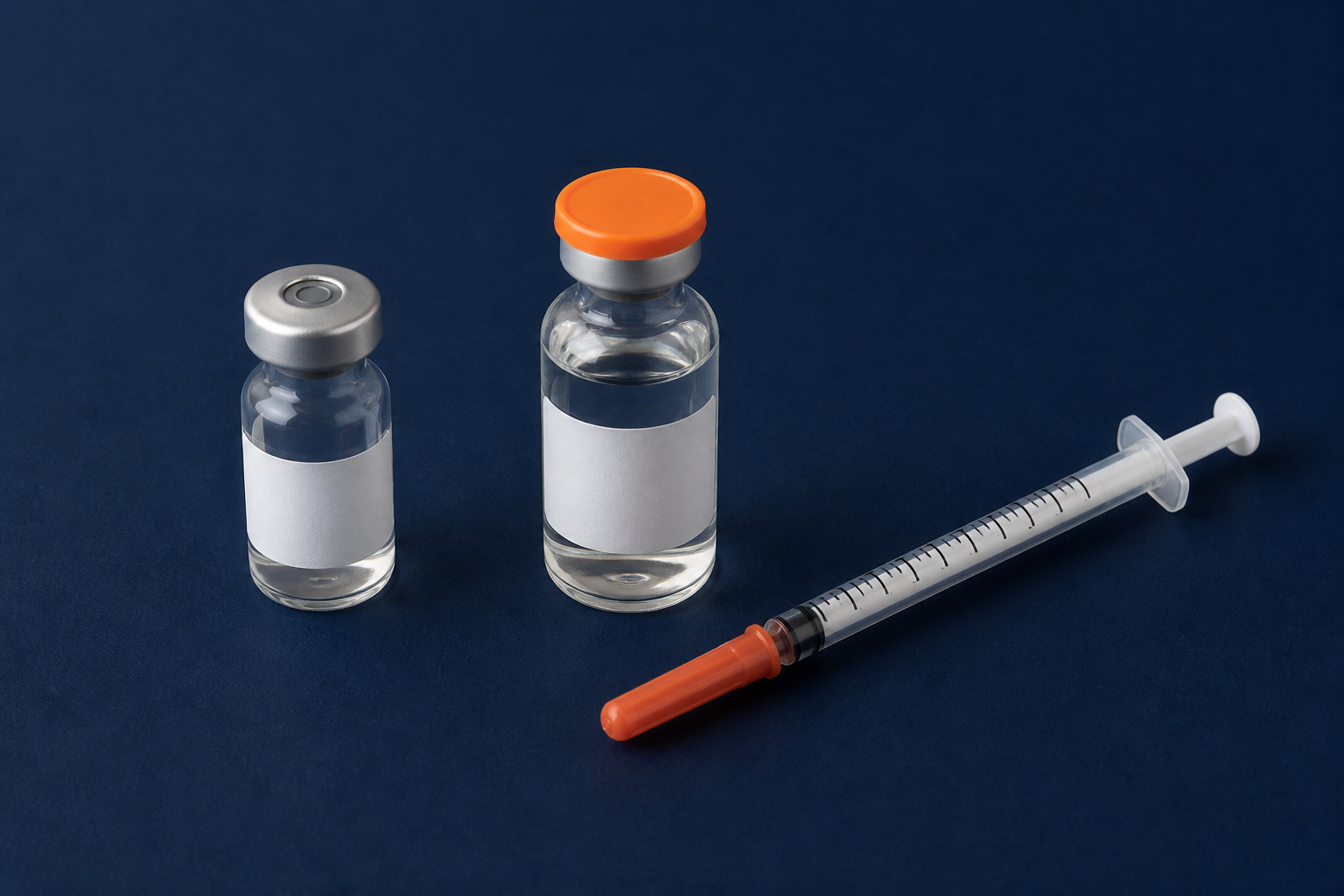
Basic example limit: 3 mL maximum. Check the actual vial and product-specific limits.
resulting U-100 draw
resulting U-100 draw
Shown in the diagram. Closest of these examples to 25 units.
resulting U-100 draw
Formula: draw units = selected mg × BAC mL ÷ vial mg × 100. The 20-30 unit band is a measurement reference, not a recommendation. Results are mathematical examples, not preparation instructions.
Each card states what the quantities are based on. A third-party or animal schedule is not a validated human dose.
2 mg daily in weeks 1-2, 3 mg in weeks 3-4, 4 mg in weeks 5-8 and 5 mg in weeks 9-12
The guide itself notes the absence of a matched human randomised dose-finding programme. These are retail educational conventions, not validated posology.
View sourceThe spotlight states 20-40 mg orally for 10-20 days or 0.1 mg subcutaneously or intramuscularly three times daily for one month
Later community reports instead cluster around 1-2 mg daily for roughly 20-30 days, with still higher outliers. The archive does not reconcile the order-of-magnitude conflict; raw/bioregulators/bio-cartalax.md:22-24 and 257-280.
View sourceSubcutaneous reports cluster around 1-2 mg once daily in roughly 20-day cycles (some 30-40 days), with about 2-month breaks and 3-4 cycles a year; several researchers titrate to 3-5 mg daily, injections are often placed locally near the affected joint, and it is sold mainly as 20 mg vials
Forum provenance from an authenticated archive with usernames omitted. Reported outcomes are mixed and confounded because it is almost always stacked with ARA-290, KPV, BPC-157 or TB-500; the subcutaneous route dominates with an oral capsule form noted separately, and quantities are not interconverted between routes.
View sourceA short peptide bioregulator marketed for cartilage-related claims. Internationally indexed controlled human evidence is too sparse to establish a protocol.
The page records the evidence search and absence of a reproducible indexed human schedule rather than filling the gap with vendor conventions.
An authenticated research-forum archive records subcutaneous Cartalax around 1-2 mg once daily in roughly 20-day cycles, with about two-month breaks and three to four cycles a year; several reports titrate to 3-5 mg daily and many inject locally near the affected joint. Outcomes are mixed and hard to isolate because it is almost always stacked with ARA-290, KPV, BPC-157 or TB-500, and it is sold mainly as 20 mg vials with an oral capsule form noted separately. The archive does not reconcile this sub-milligram-to-5 mg spread with older channel figures that cited far higher oral or divided quantities. Usernames are omitted and the planner above reproduces the arithmetic of the reported quantities rather than validating them.
Human pharmacokinetics, controlled efficacy, adverse-event frequency and a validated formulation remain unknown.
Shared across protocols
Keep the universal checklist short. Product-specific labelling and source documentation always take priority over a general guide.
Select the labelled vial quantity used in the calculation.
View Peppys vialUse only a diluent appropriate to the research method and formulation.
View Peppys BAC waterUse a new sterile device for every entry. Source locally.
Source locallyPlan clean handling and immediate sharps disposal. Source locally.
Source locallyDo not apply a universal refrigerator rule. Follow the product, diluent and study documentation for temperature, light and expiry.
CDC injection-safety guidance calls for a new sterile needle and syringe for each injection and entry into a medication container.
Do not infer a post-mixing lifetime from BAC water alone. Discard material when identity, integrity or sterility is in doubt.