1 mL BAC
6 units
resulting U-100 draw
- Concentration
- 10 mg/mL
- BAC added
- 1 mL
A long-acting amylin analogue under clinical investigation for weight management, with dose-ranging human evidence but no routine-use authorisation.
Quantities below reproduce their stated source context—label, human study, laboratory work or educational guide. They do not assess suitability, product equivalence or individual risk.
Phase 2 dose-finding study
The line reproduces the five cagrilintide arms and their two-week escalation intervals from the registered 26-week phase 2 study.
Vial-aware arithmetic
Choose the vial quantity and BAC water first. The diagram and results below update for the selected 0.6 mg study quantity. Higher-strength vials may naturally land outside the 20-30 unit band.
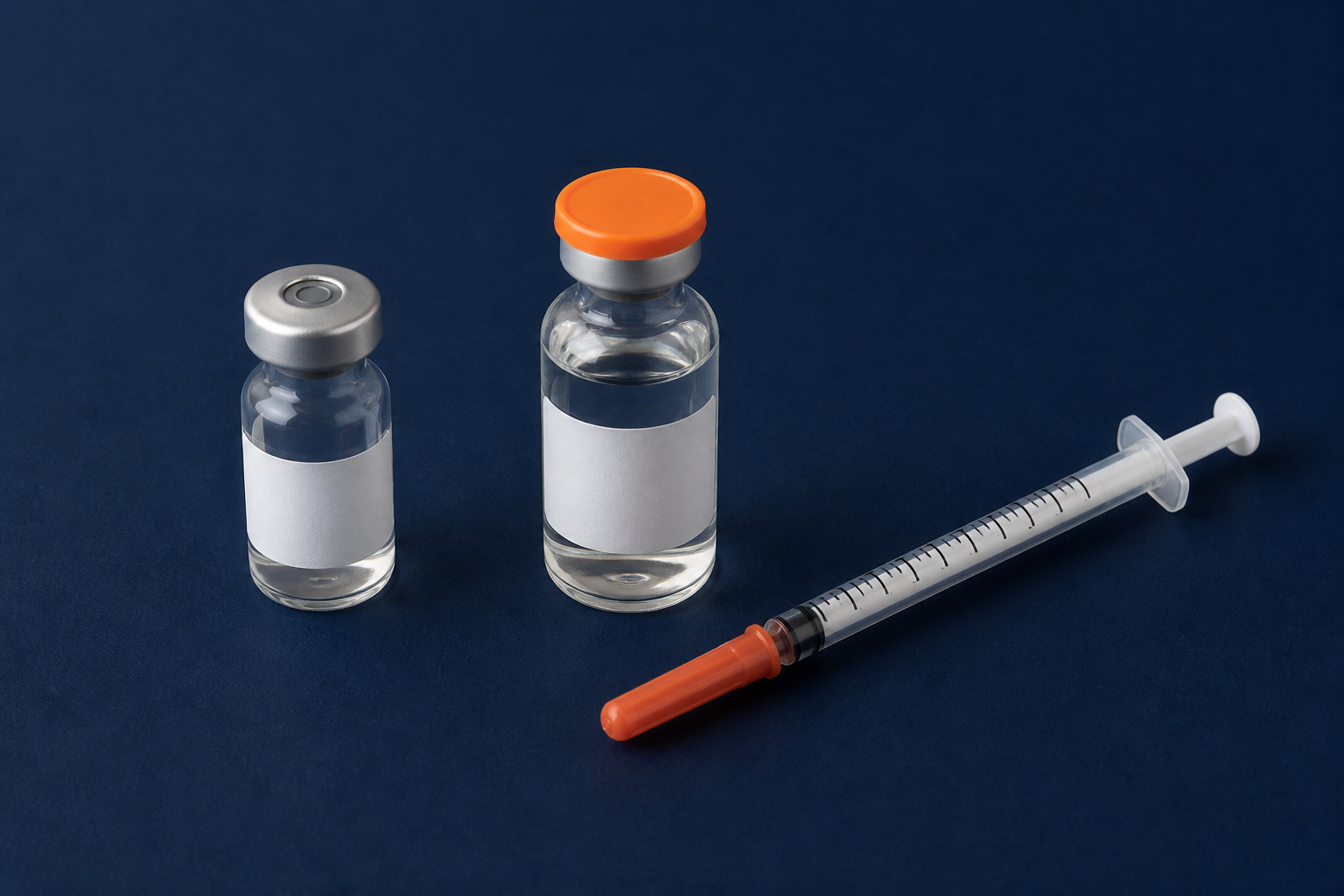
Basic example limit: 3 mL maximum. Check the actual vial and product-specific limits.
resulting U-100 draw
resulting U-100 draw
resulting U-100 draw
Shown in the diagram. Closest of these examples to 25 units.
Formula: draw units = selected mg × BAC mL ÷ vial mg × 100. The 20-30 unit band is a measurement reference, not a recommendation. Results are mathematical examples, not preparation instructions.
Each card states what the quantities are based on. A third-party or animal schedule is not a validated human dose.
Once-weekly dose-finding arms of 0.3 mg, 0.6 mg, 1.2 mg, 2.4 mg and 4.5 mg with escalation every 2 weeks
Phase 2 research allocation over 26 weeks with placebo and liraglutide comparators.
View sourceLow-dose stacking reports cluster around 0.125-0.25 mg subcutaneously once weekly, with most surveyed users below 0.5 mg weekly
These are community experiments, not trial arms. The same channel reports responses ranging from 70-80 mcg being strong to 1.2 mg or more producing little effect, alongside fatigue and mood complaints; raw/incretin-mimetics/im-cagrilintide.md:3041-3160.
View sourceThe phase 2 dose-finding study evaluated several assigned doses and an active comparator. It was designed to characterise efficacy, tolerability and dose response under research monitoring.
Trial arms should not be converted into self-directed schedules. Ongoing development may change the selected formulation, regimen and regulatory conclusions.
Shared across protocols
Keep the universal checklist short. Product-specific labelling and source documentation always take priority over a general guide.
Select the labelled vial quantity used in the calculation.
View Peppys vialUse only a diluent appropriate to the research method and formulation.
View Peppys BAC waterUse a new sterile device for every entry. Source locally.
Source locallyPlan clean handling and immediate sharps disposal. Source locally.
Source locallyDo not apply a universal refrigerator rule. Follow the product, diluent and study documentation for temperature, light and expiry.
CDC injection-safety guidance calls for a new sterile needle and syringe for each injection and entry into a medication container.
Do not infer a post-mixing lifetime from BAC water alone. Discard material when identity, integrity or sterility is in doubt.