1 mL BAC
10 units
resulting U-100 draw
- Concentration
- 10 mg/mL
- BAC added
- 1 mL
A melanocortin receptor agonist with an authorised US auto-injector for a defined indication. Research-vial calculations are not equivalent to the regulated product.
Quantities below reproduce their stated source context—label, human study, laboratory work or educational guide. They do not assess suitability, product equivalence or individual risk.
Community-reported schedule
Community-reported · not a validated scheduleCommunity-provenance subcutaneous PT-141 taken as needed, from about 300 mcg to 2 mg. Forum reports only, distinct from and not a substitute for the 1.75 mg authorised Vyleesi auto-injector.
Vial-aware arithmetic
Choose the vial quantity and BAC water first. The diagram and results below update for the selected 1 mg reported quantity. Higher-strength vials may naturally land outside the 20-30 unit band.
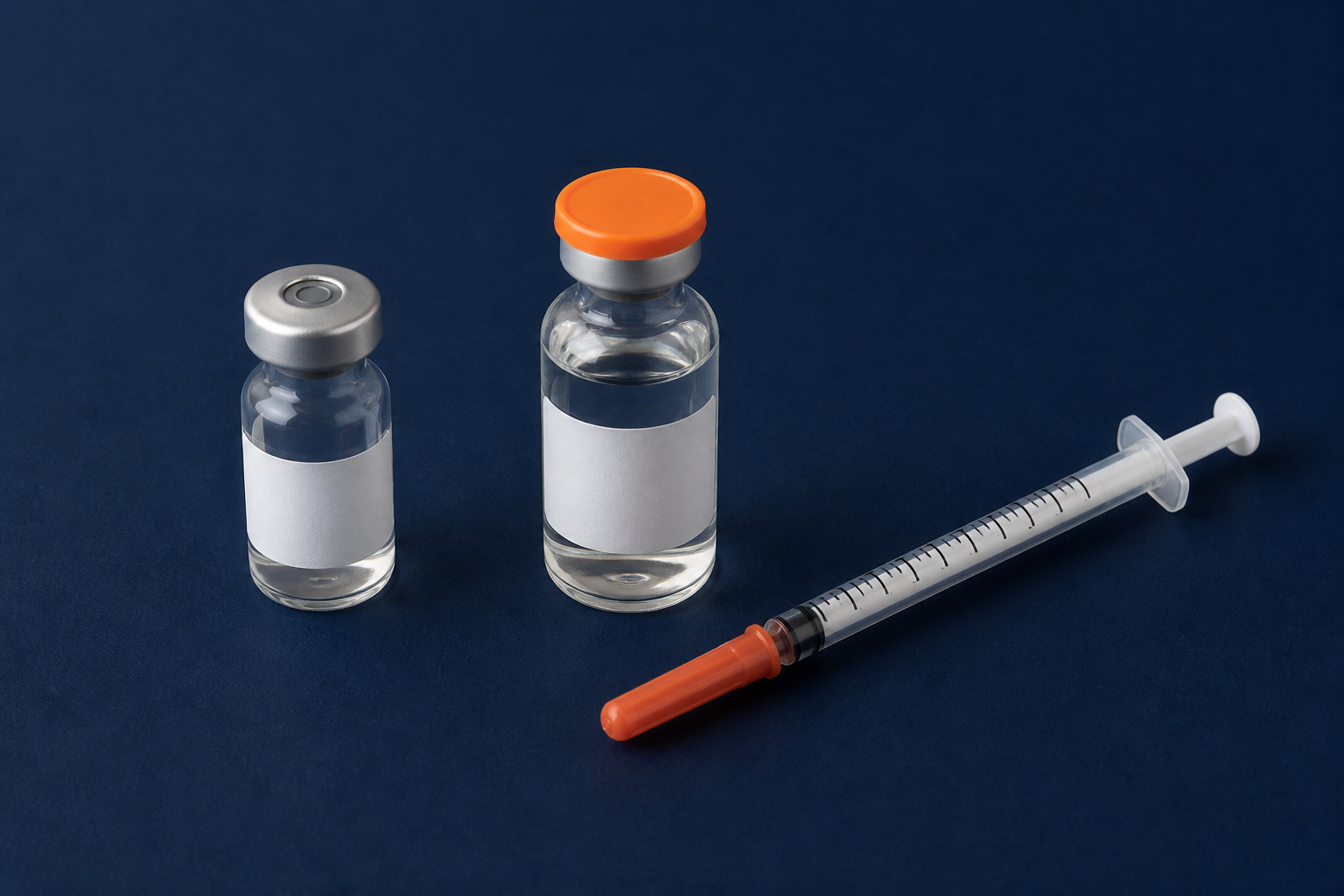
Basic example limit: 3 mL maximum. Check the actual vial and product-specific limits.
resulting U-100 draw
resulting U-100 draw
Shown in the diagram. Closest of these examples to 25 units.
resulting U-100 draw
Formula: draw units = selected mg × BAC mL ÷ vial mg × 100. The 20-30 unit band is a measurement reference, not a recommendation. Results are mathematical examples, not preparation instructions.
Each card states what the quantities are based on. A third-party or animal schedule is not a validated human dose.
The label specifies a fixed 1.75 mg subcutaneous auto-injector used when needed, no more than once per 24 hours or eight times per month
This describes the regulated presentation only and requires the full label and clinical assessment. It is not a conversion rule for research vials.
View sourceThe channel commonly reports 1-2 mg subcutaneously as needed, but perceived onset is often 2-8 hours rather than the pinned 30-minute timing
These reports are not interchangeable with the 1.75 mg authorised presentation. The archive also contains wider 0.5-3 mg anecdotes; raw/peptide-education/pe-bremelanotide-pt141.md:18-21, 100-105 and 377-382.
View sourceSubcutaneous as-needed dosing that begins low (125-500 mcg, some microdosing about 300 mcg) and titrates, with males landing roughly 1-2.5 mg and females roughly 0.5-1.7 mg; members repeat that doses stay at least 72 hours apart and under about 8 mg per month, and note the effect can fade with larger or more frequent dosing
Forum provenance from an authenticated archive with usernames omitted. These figures are not interchangeable with the fixed 1.75 mg authorised auto-injector; reports conflict on the female dose (a clinician chart lists 2 mg where the community caps nearer 1 mg), and nausea, flushing and skin darkening drive the low-and-slow pattern.
View sourceThe authorised product uses a fixed-dose device for a defined population. Its efficacy and safety evidence cannot validate a separately sourced research vial.
The full label describes transient blood-pressure changes, focal hyperpigmentation, nausea and medicine interactions related to slowed gastric emptying.
An authenticated research-forum archive records subcutaneous PT-141 taken as needed, beginning low around 125-500 mcg and titrating, with male reports clustering near 1-2.5 mg and female reports nearer 0.5-1.7 mg. Members repeatedly cap frequency at roughly 8 mg per month with at least 72 hours between doses, and note the effect can diminish with larger or more frequent use. These forum quantities are not interchangeable with the fixed 1.75 mg authorised auto-injector, the reports conflict on the female dose against the clinician charts, and nausea, flushing and skin darkening are the commonly logged reasons for staying conservative. Usernames are omitted and the planner above reproduces the arithmetic of the reported quantities rather than validating them.
Shared across protocols
Keep the universal checklist short. Product-specific labelling and source documentation always take priority over a general guide.
Select the labelled vial quantity used in the calculation.
View Peppys vialUse only a diluent appropriate to the research method and formulation.
View Peppys BAC waterUse a new sterile device for every entry. Source locally.
Source locallyPlan clean handling and immediate sharps disposal. Source locally.
Source locallyDo not apply a universal refrigerator rule. Follow the product, diluent and study documentation for temperature, light and expiry.
CDC injection-safety guidance calls for a new sterile needle and syringe for each injection and entry into a medication container.
Do not infer a post-mixing lifetime from BAC water alone. Discard material when identity, integrity or sterility is in doubt.