1 mL BAC
50 units
resulting U-100 draw
- Concentration
- 4 mg/mL
- BAC added
- 1 mL
Shown in the diagram. Closest of these examples to 25 units.
An erythropoietin-derived tissue-protective peptide studied in small phase 2 neuropathy trials. Schedules are disease-specific and remain investigational.
Quantities below reproduce their stated source context—label, human study, laboratory work or educational guide. They do not assess suitability, product equivalence or individual risk.
Community-reported schedule
Community-reported · not a validated scheduleCommunity-provenance subcutaneous dosing from an authenticated research forum, about 1.3-4 mg once daily (commonly 2 mg) in roughly 30-day courses. Forum reports only, not a validated or trial-verified schedule.
Vial-aware arithmetic
Choose the vial quantity and BAC water first. The diagram and results below update for the selected 2 mg reported quantity. Higher-strength vials may naturally land outside the 20-30 unit band.
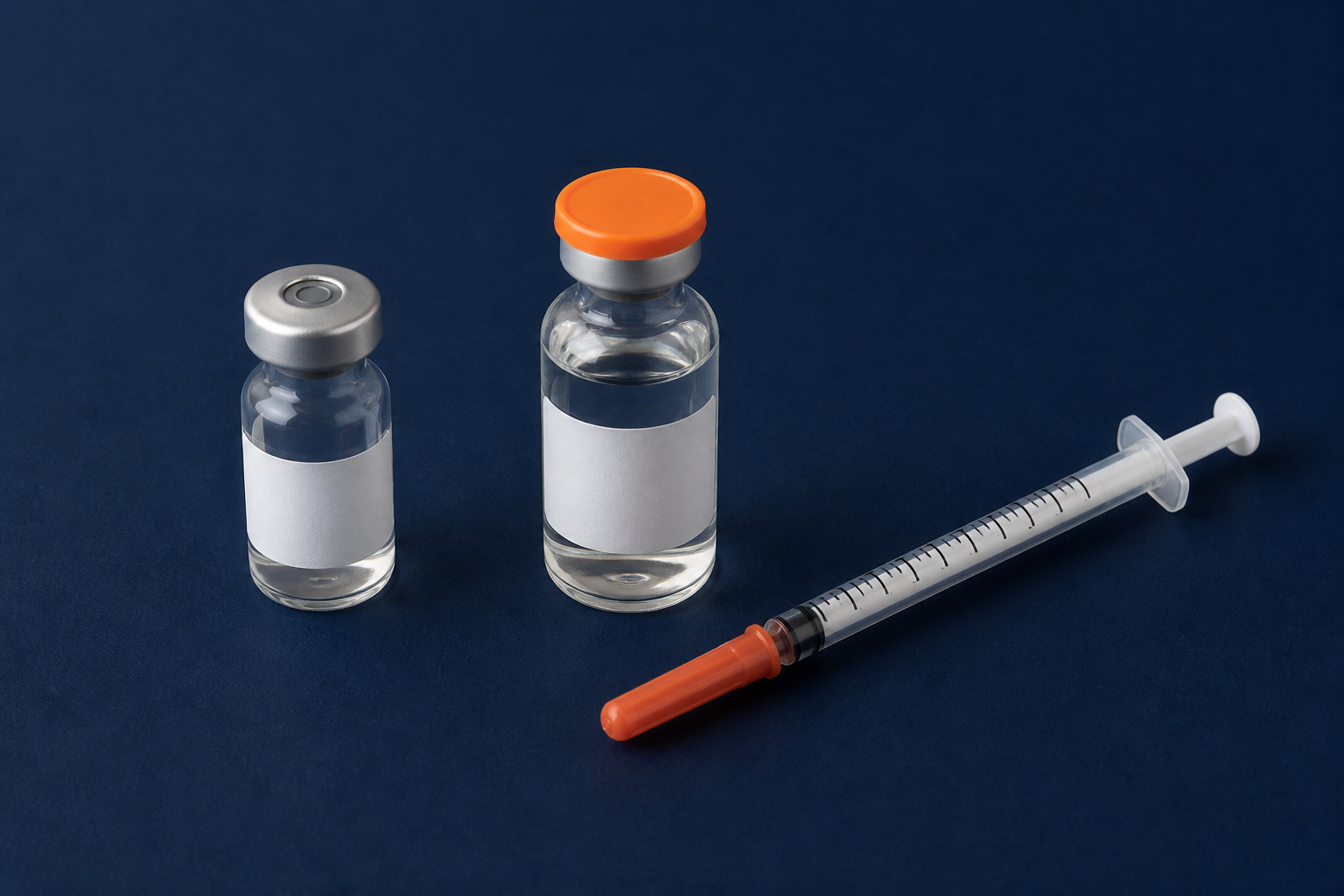
Basic example limit: 3 mL maximum. Check the actual vial and product-specific limits.
resulting U-100 draw
Shown in the diagram. Closest of these examples to 25 units.
resulting U-100 draw
resulting U-100 draw
This draw exceeds a 1 mL U-100 syringe.
Formula: draw units = selected mg × BAC mL ÷ vial mg × 100. The 20-30 unit band is a measurement reference, not a recommendation. Results are mathematical examples, not preparation instructions.
Each card states what the quantities are based on. A third-party or animal schedule is not a validated human dose.
4 mg subcutaneously once daily for 28 days
This phase 2 schedule was followed by another 28 days of observation and is not a routine-use protocol.
View sourceReports include 1 mg daily for 30 days, 2.5 mg before exercise and 4 mg daily in multi-compound inflammation or pain stacks
These anecdotes are mixed and confounded. The 4 mg amount resembles a study quantity but does not reproduce the studied population, 28-day design or monitoring; raw/peptide-education/pe-tb-500-frag.md:247-249 and raw/discussions/disc-ask-med-expert.md:8935-8938.
View sourceSubcutaneous reports cluster around 1.3-4 mg once daily (most settling near 2 mg, a few titrating to 6 mg) in roughly 30-day courses with about 60-day breaks; because the peptide tends to gel or cloud, members add plenty of bacteriostatic water plus sodium bicarbonate, or a few drops of injectable acetic acid, and aim for pH around 4-5
Forum provenance from an authenticated archive with usernames omitted. Reported quantities are consistent for neuropathic and anti-inflammatory use but are not a controlled schedule; the subcutaneous route is preferred, with intranasal noted only as a possible alternative, and quantities are not interconverted between routes.
View sourceAn erythropoietin-derived tissue-protective peptide studied in small phase 2 neuropathy trials. Schedules are disease-specific and remain investigational.
The page reports the repeated 28-day subcutaneous research design used in small neuropathy studies, with the population and monitoring context attached.
An authenticated research-forum archive records subcutaneous ARA-290 clustering around 1.3-4 mg once daily, most reports settling near 2 mg and a few titrating as high as 6 mg, run in roughly 30-day courses with about 60-day breaks. The recurring technical theme is reconstitution: the peptide tends to gel or cloud, so members add plenty of bacteriostatic water plus sodium bicarbonate, or a few drops of injectable acetic acid, aiming for a pH near 4-5. Reports are consistent and positive for neuropathic and anti-inflammatory use, with benefit fading after discontinuation; the subcutaneous route is preferred and intranasal is mentioned only as a possible alternative, without interconverting quantities. Usernames are omitted and the planner above reproduces the arithmetic of the reported quantities rather than validating them.
Larger confirmatory trials, long-term safety, approved indications and equivalence to commercial research vials remain unresolved.
Shared across protocols
Keep the universal checklist short. Product-specific labelling and source documentation always take priority over a general guide.
Select the labelled vial quantity used in the calculation.
View Peppys vialUse only a diluent appropriate to the research method and formulation.
View Peppys BAC waterUse a new sterile device for every entry. Source locally.
Source locallyPlan clean handling and immediate sharps disposal. Source locally.
Source locallyDo not apply a universal refrigerator rule. Follow the product, diluent and study documentation for temperature, light and expiry.
CDC injection-safety guidance calls for a new sterile needle and syringe for each injection and entry into a medication container.
Do not infer a post-mixing lifetime from BAC water alone. Discard material when identity, integrity or sterility is in doubt.