1 mL BAC
10 units
resulting U-100 draw
- Concentration
- 15 mg/mL
- BAC added
- 1 mL
A growth-hormone-axis blend not represented by the authorised tesamorelin product or by the intravenous ipamorelin clinical programme.
Quantities below reproduce their stated source context—label, human study, laboratory work or educational guide. They do not assess suitability, product equivalence or individual risk.
Community-reported schedule
Community-reported · not a validated scheduleA community Tesamorelin / Ipamorelin blend shown as total mass per subcutaneous injection from a 15 mg vial (10 mg Tesa + 5 mg Ipa, 2:1). The name implies 1:1 and separate-component reports run about 8:1, so ratios conflict; community reports only, not validated.
Vial-aware arithmetic
Choose the vial quantity and BAC water first. The diagram and results below update for the selected 1.5 mg total reported quantity. Higher-strength vials may naturally land outside the 20-30 unit band.
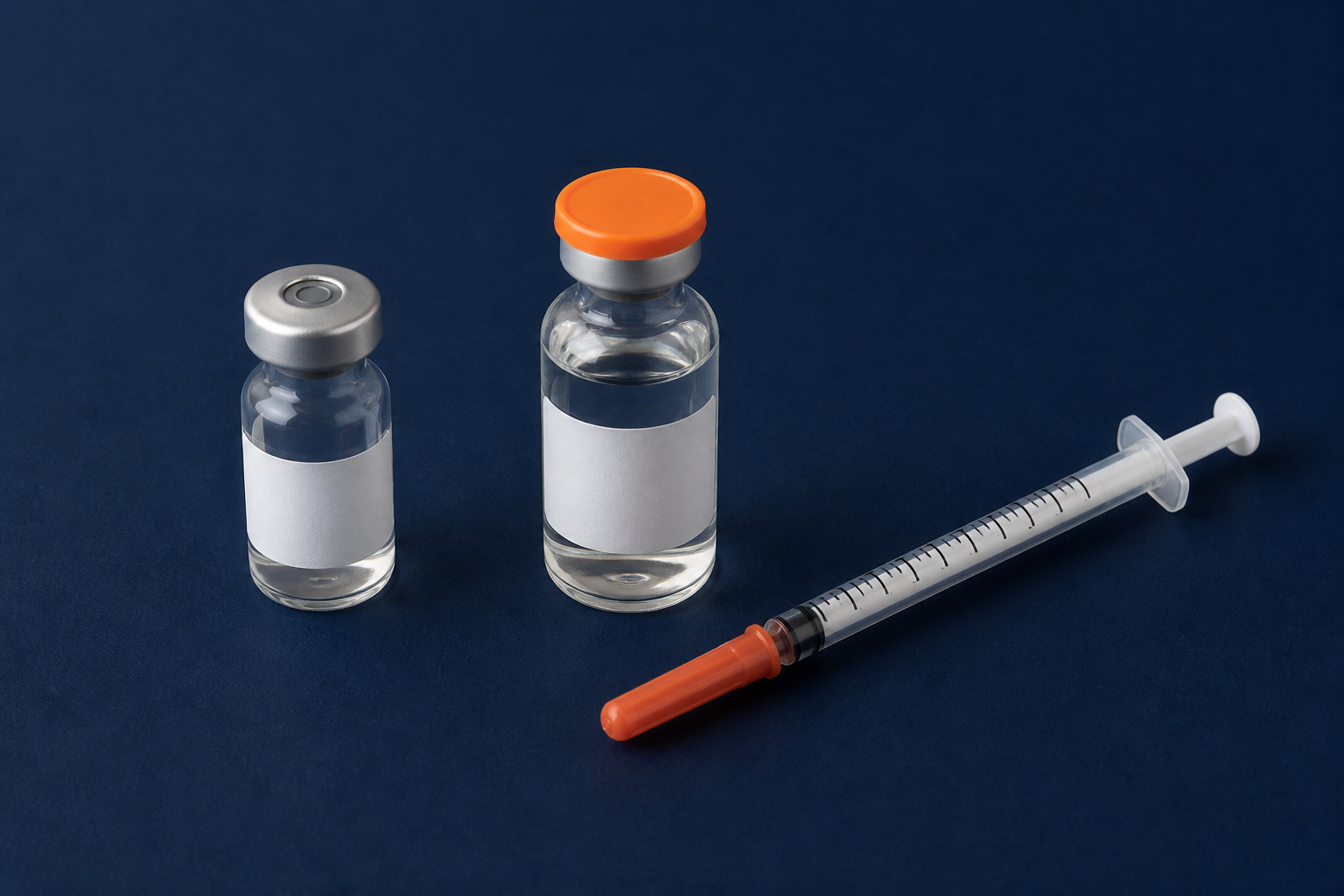
Basic example limit: 3 mL maximum. Check the actual vial and product-specific limits.
resulting U-100 draw
resulting U-100 draw
Shown in the diagram. Closest of these examples to 25 units.
resulting U-100 draw
Formula: draw units = selected mg × BAC mL ÷ vial mg × 100. The 20-30 unit band is a measurement reference, not a recommendation. Results are mathematical examples, not preparation instructions.
Each card states what the quantities are based on. A third-party or animal schedule is not a validated human dose.
Every draw from a true 1:1 blend delivers equal milligram quantities of tesamorelin and ipamorelin
The referenced third-party page proposes unequal 2:1 component quantities, which cannot be obtained from a homogeneous 1:1 vial. No compatible combined schedule is therefore displayed.
View sourceThe best-documented phases used 1 mg tesamorelin plus 250 mcg ipamorelin and 2 mg plus 500 mcg once daily in the morning for three weeks
These unequal ratios came from separately measured components and cannot be reproduced from a homogeneous 1:1 blend. Other channel examples use different ratios and timing; raw/growing-pains-ghrh-gh-igf-insulin.md:31-37.
View sourceThe best-documented forum logs run Tesamorelin 1-2 mg subcutaneously with Ipamorelin about 200-250 mcg, most often once daily fasted in the morning or with Tesamorelin at bedtime and Ipamorelin split; several note that 1 mg Tesamorelin alone can already push IGF-1 to the top of range and that Ipamorelin roughly amplifies the effect, so some run as little as 100-200 mcg of each. These are separately measured components at roughly an 8:1 Tesamorelin-to-Ipamorelin ratio, not a homogeneous 1:1 blend
Forum provenance from an authenticated archive with usernames and post numbers omitted. The reported ratios of about 5-10:1 Tesamorelin to Ipamorelin cannot be reproduced from a 1:1 vial; quantities conflict and are titrated against IGF-1 testing. These are community provenance, not controlled human dose finding, and the growth-hormone-axis components are kept separate rather than interconverted.
View sourceA growth-hormone-axis blend not represented by the authorised tesamorelin product or by the intravenous ipamorelin clinical programme.
The components have evidence in different formulations, routes and populations. No source establishes that combining them produces an equivalent or acceptable protocol.
Although the archive's cautious top-line flag understates it, the forum in fact carries a curated Tesamorelin and Ipamorelin protocol and several detailed logs. Those reports run Tesamorelin around 1-2 mg subcutaneously with Ipamorelin near 200-250 mcg, most often once daily fasted in the morning or with Tesamorelin at bedtime and Ipamorelin split, and titrate against IGF-1 testing; some observe that 1 mg of Tesamorelin alone already tops the IGF-1 range and that Ipamorelin amplifies the effect, so they run lower amounts of each. Critically, these are separately measured components at roughly an 8:1 Tesamorelin-to-Ipamorelin ratio, which the blend's display name (implying 1:1) does not reflect and a homogeneous vial cannot reproduce. Reported quantities conflict, usernames and post numbers are omitted, and the figures are community provenance; the planner above shows only the arithmetic of a fixed-ratio blend and does not validate it.
Combined exposure, endocrine effects, formulation compatibility, long-term safety and clinical benefit are unknown.
Shared across protocols
Keep the universal checklist short. Product-specific labelling and source documentation always take priority over a general guide.
Select the labelled vial quantity used in the calculation.
View Peppys vialUse only a diluent appropriate to the research method and formulation.
View Peppys BAC waterUse a new sterile device for every entry. Source locally.
Source locallyPlan clean handling and immediate sharps disposal. Source locally.
Source locallyDo not apply a universal refrigerator rule. Follow the product, diluent and study documentation for temperature, light and expiry.
CDC injection-safety guidance calls for a new sterile needle and syringe for each injection and entry into a medication container.
Do not infer a post-mixing lifetime from BAC water alone. Discard material when identity, integrity or sterility is in doubt.