1 mL BAC
10 units
resulting U-100 draw
- Concentration
- 10 mg/mL
- BAC added
- 1 mL
A combined research product without controlled human evidence for the mixture. Component-level preclinical claims do not establish compatibility or a blend protocol.
Quantities below reproduce their stated source context—label, human study, laboratory work or educational guide. They do not assess suitability, product equivalence or individual risk.
Community-reported schedule
Community-reported · not a validated scheduleA community 1:1 BPC-157 / TB-4 blend reconstituted in one vial (10 mg = 5 mg + 5 mg), shown as total blend mass per subcutaneous injection - loading then a lower maintenance phase. Community reports only, not a validated schedule.
Vial-aware arithmetic
Choose the vial quantity and BAC water first. The diagram and results below update for the selected ~1 mg total reported quantity. Higher-strength vials may naturally land outside the 20-30 unit band.
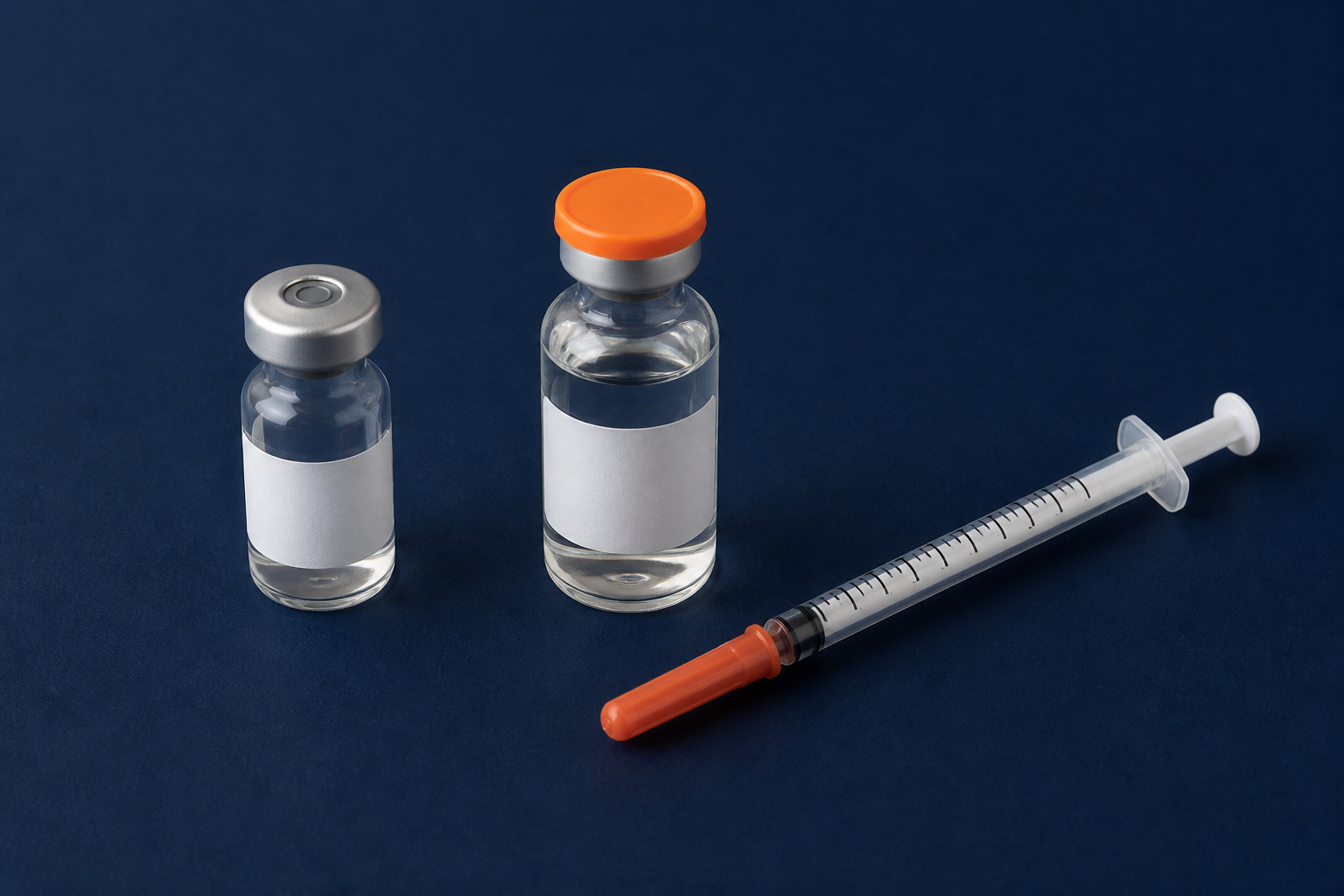
Basic example limit: 3 mL maximum. Check the actual vial and product-specific limits.
resulting U-100 draw
resulting U-100 draw
Shown in the diagram. Closest of these examples to 25 units.
resulting U-100 draw
Formula: draw units = selected mg × BAC mL ÷ vial mg × 100. The 20-30 unit band is a measurement reference, not a recommendation. Results are mathematical examples, not preparation instructions.
Each card states what the quantities are based on. A third-party or animal schedule is not a validated human dose.
600 mcg total daily in weeks 1-2, 800 mcg in weeks 3-4 and 600 mcg in weeks 5-8, delivering equal mass of each component
This is a community blend convention with no controlled human mixture study. It cannot establish component identity, compatibility or a validated outcome.
View sourceDaily reports commonly use about 250-750 mcg of each component once or twice daily; one channel summary gives BPC-157 200-500 mcg daily plus full-length TB4 500-1,000 mcg daily or 2-4 mg twice weekly
The archive frequently interchanges TB-500 fragment and full-length thymosin beta-4, so these schedules are not molecularly equivalent. No controlled human mixture study is documented; raw/peptide-education/pe-bpc-157.md:197-216 and 1332-1340.
View sourceAn authenticated forum protocol reconstitutes BPC-157 and TB-4 together as a 1:1 blend in one vial and doses 350-650 mcg of each component subcutaneously three times daily for 5-10 days of loading, stepping down to roughly 350 mcg of each once or twice daily for maintenance; the same archive treats the peptide sold today as TB-500 as short-acting TB-4 and keeps a separate BPC-157 eye-drop protocol that is not injected
Forum provenance from an authenticated archive with usernames and post numbers omitted. The community claim that current TB-500 is TB-4 (CAS 77591-33-4) drives the daily, BPC-like schedule; reported quantities conflict and no controlled human study of the mixture exists. Subcutaneous and ophthalmic uses are kept separate rather than interconverted.
View sourceA combined research product without controlled human evidence for the mixture. Component-level preclinical claims do not establish compatibility or a blend protocol.
The evidence is assessed component by component because no matched human trial of the blend was found. Neither component supplies a validated routine protocol.
An authenticated research-forum archive describes a 1:1 BPC-157 and TB-4 blend reconstituted in a single vial, with subcutaneous loading in the region of 350-650 mcg of each component up to three times daily for five to ten days before a lower one-to-two-times-daily maintenance phase. The archive treats the material sold today as TB-500 as short-acting TB-4, which is why it is dosed daily rather than on the older twice-weekly fragment schedule, and it keeps a separate, non-injected BPC-157 eye-drop protocol distinct from the injectable blend. Reported quantities conflict, usernames and post numbers are omitted, and the figures are logged as community provenance without endorsement. The planner above reproduces the arithmetic of these reported quantities as a total blend mass; it does not validate them.
Combined pharmacokinetics, chemical compatibility, stability, safety and clinical outcomes are unknown.
Shared across protocols
Keep the universal checklist short. Product-specific labelling and source documentation always take priority over a general guide.
Select the labelled vial quantity used in the calculation.
View Peppys vialUse only a diluent appropriate to the research method and formulation.
View Peppys BAC waterUse a new sterile device for every entry. Source locally.
Source locallyPlan clean handling and immediate sharps disposal. Source locally.
Source locallyDo not apply a universal refrigerator rule. Follow the product, diluent and study documentation for temperature, light and expiry.
CDC injection-safety guidance calls for a new sterile needle and syringe for each injection and entry into a medication container.
Do not infer a post-mixing lifetime from BAC water alone. Discard material when identity, integrity or sterility is in doubt.